
Did Banksy Just Crash London’s Statue Debate Again? Inside the Mystery Monument Shaking Up Trafalgar Square
A mysterious new statue in central London, seemingly tagged with Banksy’s unmistakable signature, has transformed an ordinary plinth into a live debate about power, protest, and public art. As crowds gather to photograph the figure of a man marching blindly off his pedestal, the installation is already reshaping conversations around monuments, street art, and who gets to stand on a pedestal in 2026.
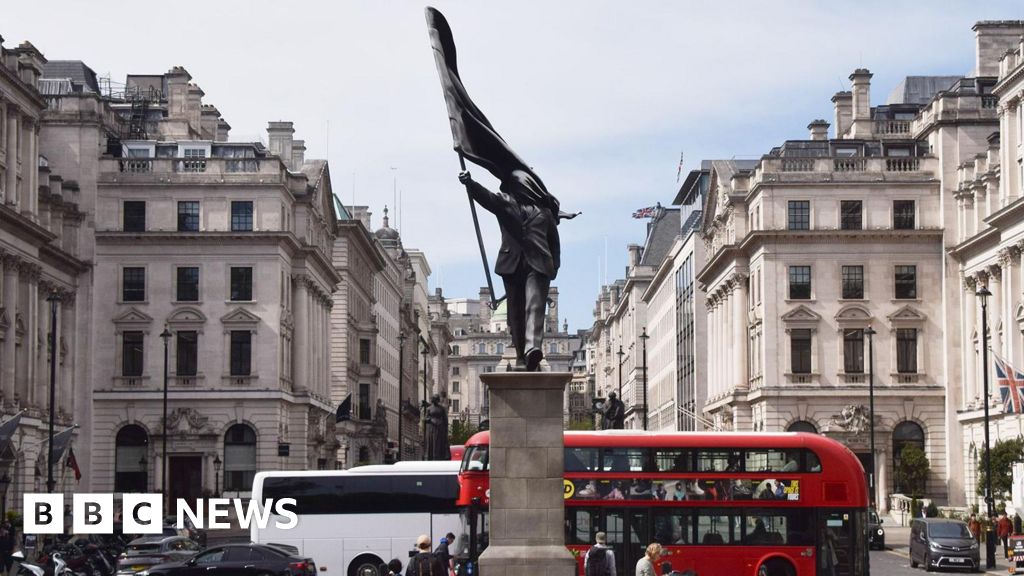
The work, a sculpture of a man in a suit striding off a plinth while clutching a flag that completely blocks his vision, appeared almost overnight and has been pulling in tourists, commuters, and street-art pilgrims in equal measure. With Banksy’s “signature” reportedly visible on the piece and BBC podcast host James Peak calling it a “brilliant comment” on power and blindness, the statue feels like a very 2026 collision of protest art, political satire, and selfie culture.
Banksy, London, and the Politics of the Plinth
To understand why this statue is instantly viral, you have to place it in two overlapping stories: Banksy’s long-running guerrilla art campaign and London’s ongoing argument with its own monuments.
Banksy, the still-anonymous street artist whose work has sold for millions while appearing unannounced on city walls, has built a career on hijacking public space. From the Girl with Balloon shredding stunt at Sotheby’s to the dystopian theme park Dismaland, his pieces often blur the line between prank, protest, and prestige art. So a “Banksy” statue suddenly materializing in central London is not just a visual gag; it’s a continuation of a career-long performance about who gets to author the city.
At the same time, London’s plinths have been politically charged terrain for years. The Fourth Plinth in Trafalgar Square has hosted rotating contemporary commissions that respond—often critically—to the imperial statues around it. Add in recent global debates over colonial monuments and the toppling or removal of controversial figures, and a new “unofficial” statue of a powerful man literally walking off his pedestal arrives with some serious cultural baggage.
What the Statue Shows: Blind March of the Powerful
The statue’s core image is disarmingly simple: a man in business attire, chest slightly puffed, stepping outward from a classical-style pedestal. In one hand he clutches a large flag which completely obscures his field of vision. The gesture is confident—almost triumphant—yet the staging makes it clear he has no idea where he’s heading.
“Here, you've got a brilliant comment on a bumptious, chest puffed out man in power with the flag completely obscuring his vision…”
— James Peak, creator of The Banksy Story podcast for the BBC
Visually, it taps into a long tradition of heroic monuments—figures raised above the crowd, flags held aloft—only to undercut that iconography with a slapstick edge. It’s equal parts political cartoon and solemn sculpture, which is exactly Banksy’s sweet spot: you get the joke in a second, then spend a lot longer thinking about it.
Reading the Message: Nationalism, Hubris, and the Edge of the Plinth
The symbolism is not subtle, but it is layered. On the most immediate level, the piece plays as a satire of political leaders and corporate elites who charge ahead waving the flag while being functionally blind to consequences. The flag—normally a rallying point—turns into a literal obstruction, a fabric blindfold held up with pride.
- Nationalism as blindfold: The flag suggests that patriotic spectacle can obscure reality rather than clarify it.
- Falling off the pedestal: The step off the plinth hints at downfall, misstep, or a forced return to ground level.
- Public complicity: Crowds gather to watch—and to film—this impending fall, raising questions about our own role as spectators.
In the wider context of post-Brexit Britain, culture-war skirmishes, and rolling political upheaval, the statue inevitably reads as a jab at leaders marching the country toward unpredictable edges. But it’s flexible enough to travel: viewers can easily map the image onto global strongmen, corporate boards, or any swaggering figure whose worldview stops at the edge of their own banner.
Is It Really Banksy? The Signature, the Hype, and the Brand
The BBC reports that Banksy’s signature appears on the statue, and that alone is enough to trigger a full-blown media cycle. Yet with this artist, a signature is never just authentication; it’s also part of the theater. In the past, unverified “Banksys” have surfaced, and the artist’s own authentication body, Pest Control, has had to step in to clarify what’s real.
What matters culturally, though, is that the work is instantly read through the Banksy lens—anonymous dissident, sardonic political commentary, anti-establishment yet auction-house friendly. That brand shapes how crowds interact with the statue, how quickly it spreads across social media, and how long city officials will tolerate it before deciding whether it’s art, nuisance, or both.

There’s also a sly meta-commentary here: a “statue” is one of the most official, establishment forms of art. By placing what looks like a guerrilla anti-monument right into that format—and still tagging it with a famous name—the artist collapses the distance between outsider and insider. Whether or not the piece is later “claimed” via official channels, its ambiguity is part of the experience.
Crowds, Cameras, and the Social Media Monument
The statue isn’t just designed to be looked at; it’s made to be photographed. The dramatic step off the plinth provides a perfect freeze-frame, the flag creates a clean silhouette, and the central London backdrop adds instant recognizability. In an era where “Instagrammability” can be as important as formal merit, this is tactical visual design.

Interestingly, the crowd becomes part of the piece. People gather to witness a symbol of hubris on the brink, yet their own behavior—filming, posting, turning art into content—feeds another system of power: the attention economy. Banksy’s best works have always understood this feedback loop, using virality as both subject and strategy.
Strengths and Weaknesses: Smart Satire or On-the-Nose Meme?
As with most high-profile Banksy-adjacent works, the statue lands differently depending on your tolerance for obvious symbolism.
- What works: The image reads instantly and powerfully, making it accessible beyond the usual art-world circles. It’s visually striking, contextually sharp, and perfectly timed to tap into ongoing arguments about leadership and national identity.
- What falls short: For some, the metaphor will feel a bit too clean—“man blinded by flag” isn’t exactly a cryptic puzzle. Critics who already see Banksy as the Coldplay of political art (hugely popular, instantly legible, not especially subtle) will find plenty of confirmation here.
Still, even its bluntness suits the medium. Public art competing with traffic, tourism, and the news cycle often has to speak loudly to be heard. In that regard, the statue does its job: it’s readable at a glance from across the square, yet the longer you think about its timing and placement, the sharper it becomes.
What Happens Next? The Life Cycle of a Banksy Statue
One of the most interesting questions is how long this sculpture will survive in the wild. Street pieces by Banksy are frequently removed, sold, or boxed in by plexiglass. A free-standing statue in a prime central London location raises practical questions about safety, ownership, and preservation—even as the work itself mocks the very idea of permanent monuments.
Whether it’s eventually removed, officially adopted, or quietly altered, every stage of its life will add a new chapter to the story. For now, though, it’s doing exactly what public art at its best should do: interrupt daily routine, reframe familiar spaces, and force a double take at the symbols we usually walk past without blinking.
If this statue is confirmed as an authentic Banksy, it will sit comfortably among his sharpest political gestures: direct, theatrical, and unafraid to wear its message on its sleeve—or in this case, across an entire flag. If it turns out to be an homage or a hoax, that almost feels fitting too. A piece about seeing and not seeing, about power and its blind spots, might be most honest when the authorship is just a little bit out of focus.
