
Can Stimulating Your Vagus Nerve Help Protect Memory as You Age?
Vagus Nerve Stimulation and Memory: What Science Really Says About Protecting the Aging Brain
Many people are surprised to learn that Alzheimer’s-related brain changes can start as early as our 30s, long before any memory problems appear. New research suggests that gently stimulating a key nerve—the vagus nerve—might help support the tiny brain region that keeps our attention and memory sharp, potentially slowing age-related memory loss.
If you’ve ever walked into a room and forgotten why, worried about a parent’s slipping memory, or wondered whether anything you do now can really protect your brain decades from today, you’re not alone. Researchers are asking the same questions—and are beginning to uncover some intriguing answers.
A recent discussion in The Conversation highlights a promising line of research: using vagus nerve stimulation (VNS) to support a small but mighty brain area called the locus coeruleus. Keeping this area healthy may delay or blunt symptoms of Alzheimer’s disease and age-related memory decline. This article will unpack what that means in clear, practical language—without hype—and help you understand what you can realistically do today.
Why Alzheimer’s Disease Starts Earlier Than You Think
Alzheimer’s disease is often seen as an illness of old age, but the underlying brain changes begin much earlier—sometimes around our 30s or 40s. Long before memory loss shows up, microscopic changes like amyloid plaques, tau tangles, and subtle cell damage start to accumulate.
One of the earliest and most vulnerable targets is the locus coeruleus—a tiny, blue-tinted structure deep in the brainstem. Despite its size, it plays a crucial role in:
- Regulating attention and focus
- Maintaining wakefulness and alertness
- Supporting memory encoding and consolidation
- Modulating inflammation and stress responses in the brain
As we age—and especially in the early stages of Alzheimer’s—the locus coeruleus loses neurons and becomes less efficient. Once this happens, the brain’s ability to stay sharply focused, filter information, and store new memories begins to erode.
“The locus coeruleus is often the first brain region to show Alzheimer’s-related damage. Protecting it may be one of our best strategies for preserving cognitive function as we age.”
— Adapted from current neurodegeneration research summarized in The Conversation, 2026
Meet the Vagus Nerve: Your Brain–Body Communication Superhighway
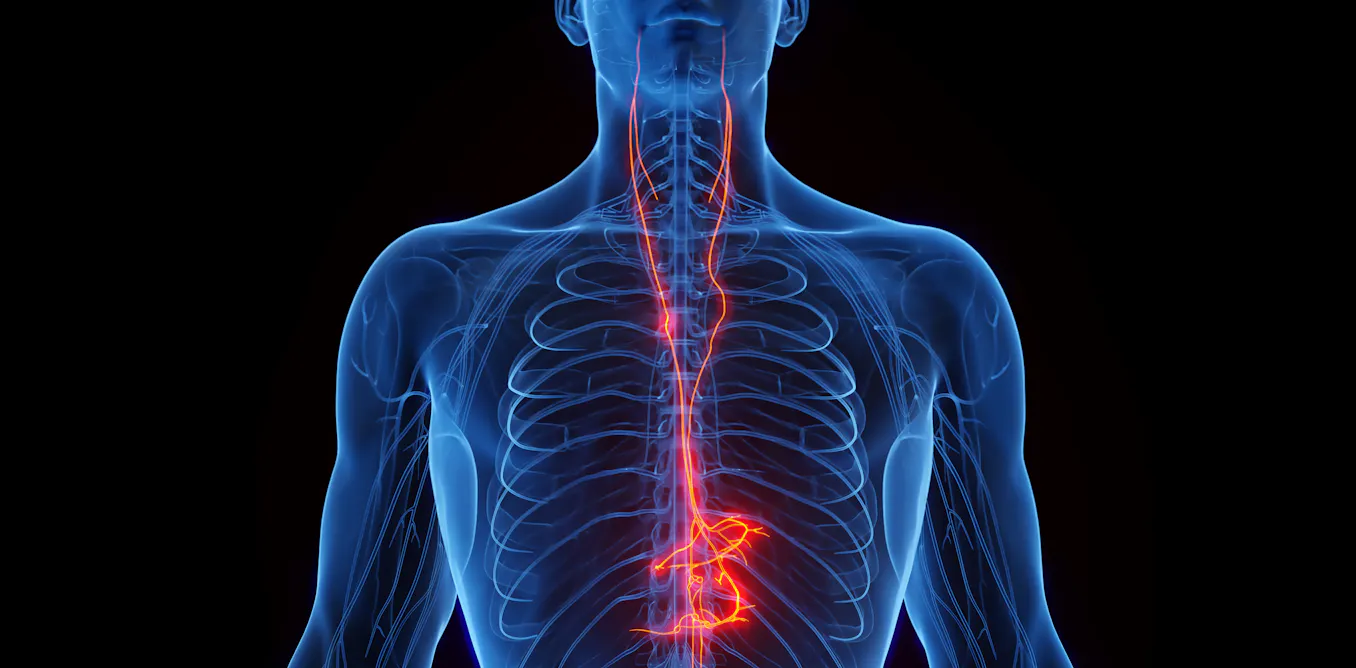
The vagus nerve is the longest cranial nerve in the body. It runs from the brainstem down through the neck into the chest and abdomen, connecting your brain with major organs like the heart, lungs, and gut.
You can think of it as a two-way communication highway:
- From body to brain: It carries information about heart rate, digestion, inflammation, and more.
- From brain to body: It helps regulate the “rest and digest” response, lowering heart rate and supporting calm, restorative states.
Crucially for memory, the vagus nerve has strong connections to the locus coeruleus. When the vagus nerve is activated in specific ways, it can trigger the locus coeruleus to release norepinephrine, a chemical messenger that enhances attention and strengthens memory formation.
What Is Vagus Nerve Stimulation (VNS)?
Vagus nerve stimulation refers to techniques that gently activate the vagus nerve using electrical or mechanical signals. There are two main categories:
- Implanted VNS devices: A small pulse generator is surgically placed under the skin of the chest, with a wire wrapped around the vagus nerve in the neck. This kind of VNS is FDA-approved for treatment-resistant epilepsy and depression, not yet for Alzheimer’s.
- Non-invasive (transcutaneous) VNS: External devices or earpieces stimulate branches of the vagus nerve through the skin, typically at the ear or neck, without surgery. These are being actively researched for several conditions, including cognitive decline.
In Alzheimer’s and aging research, scientists are especially interested in whether carefully timed VNS could:
- Boost norepinephrine release from the locus coeruleus
- Enhance attention and memory during learning tasks
- Support brain plasticity—the brain’s ability to form new connections
- Reduce harmful inflammation in the brain
“Vagus nerve stimulation doesn’t cure Alzheimer’s, but it may help the remaining brain circuits work more efficiently, buying time and preserving function in some individuals.”
— Paraphrased from emerging neuromodulation studies and expert commentary, 2024–2026
What Does the Latest Research Say About VNS and Memory?
As of early 2026, the research on vagus nerve stimulation for Alzheimer’s disease and age-related memory loss is promising but still preliminary. Here’s an evidence-based snapshot:
1. Animal Studies
- In rodent models, VNS paired with learning tasks improves memory performance and increases plasticity in the hippocampus (a key memory structure).
- Some studies show reduced inflammation and slower accumulation of Alzheimer’s-like pathology when VNS is applied early.
2. Human Studies in Other Conditions
- In people with epilepsy or depression using implanted VNS, some experience incidental improvements in alertness, mood, and aspects of cognition.
- Non-invasive VNS in healthy adults has been shown in small trials to modestly enhance attention and memory performance during specific tasks.
3. Early Alzheimer’s and Mild Cognitive Impairment (MCI)
A handful of early-phase clinical trials are exploring:
- Implanted VNS in mild to moderate Alzheimer’s disease
- Transcutaneous (ear-based) VNS in people with mild cognitive impairment
Results so far suggest:
- VNS is generally safe and tolerable when properly supervised.
- Some participants show stabilization or small improvements in cognitive test scores over 6–12 months, compared to expected decline.
- Brain imaging sometimes reveals increased activity in memory-related regions during stimulation.
However, these studies are typically small, without long-term follow-up. Larger randomized controlled trials are underway, and until those results are in, VNS for Alzheimer’s should be considered an experimental therapy, not a proven treatment.
For scientific overviews, see:
How Might VNS Protect the Locus Coeruleus and Memory?
Researchers are still piecing together the puzzle, but several mechanisms are emerging as likely contributors:
- Boosting norepinephrine release: VNS activates the brainstem, including the locus coeruleus, increasing norepinephrine. This can sharpen attention and help the brain prioritize important information.
- Enhancing synaptic plasticity: With more norepinephrine and other neuromodulators, synapses in areas like the hippocampus become more plastic—better able to form and strengthen new connections associated with memory.
- Supporting “clean-up” processes: Some animal data suggest VNS may help microglia (the brain’s immune cells) clear harmful proteins more efficiently, and improve glymphatic (waste clearance) activity during sleep.
- Reducing harmful inflammation: The vagus nerve is a key part of the “inflammatory reflex,” a system that can dial down excessive inflammation, which is increasingly implicated in Alzheimer’s and cognitive decline.
- Promoting healthier brain states: By nudging the nervous system toward a calmer, more regulated state, VNS may indirectly support better sleep, mood, and metabolic health—all important for long-term brain function.

Practical Takeaways: What Can You Do Right Now?
At this point, implanted VNS is not a standard treatment for Alzheimer’s or normal age-related forgetfulness. It’s used mainly for epilepsy and treatment-resistant depression and only considered for cognitive issues within clinical trials or highly specialized contexts.
That said, you can still support your vagus nerve, locus coeruleus, and brain health using safe, well-established strategies.
1. Evidence-Based Lifestyle “Vagus Support”
These approaches don’t deliver the same targeted stimulation as a medical VNS device, but they do engage the vagus nerve and the brain’s arousal systems in gentler ways:
- Regular aerobic exercise (like brisk walking, cycling, swimming) improves blood flow, boosts growth factors like BDNF, and supports locus coeruleus function.
- Deep, slow breathing (for example, exhaling longer than you inhale) can activate the vagus nerve and calm sympathetic “fight or flight” activation.
- Cold exposure (splashes of cool water on the face, brief cool showers) can transiently stimulate vagal pathways in some people.
- Mind–body practices such as yoga, tai chi, and meditation are linked with improved heart rate variability, an indirect sign of healthy vagal tone.
- Prioritizing sleep helps consolidate memory and maintain healthy norepinephrine rhythms from the locus coeruleus.
2. Cognitive and Social Engagement
The locus coeruleus is especially active when you are interested, challenged, and socially engaged. To keep it firing:
- Learn new skills (languages, instruments, crafts, complex games)
- Engage in meaningful conversations and social activities
- Rotate between tasks that require focus and those that allow mental rest
3. Medical Steps If You’re Concerned About Memory
If you or a loved one is noticing growing memory problems:
- Talk with a primary care clinician about a cognitive evaluation.
- Ask whether reversible contributors—such as vitamin B12 deficiency, thyroid disease, medication side effects, sleep apnea, or depression—could be playing a role.
- Discuss established Alzheimer’s treatments and clinical trial opportunities, including those exploring VNS or other neuromodulation techniques.
A Real-World Example: When VNS Helps—And When It Doesn’t
To make this more concrete, consider a composite case based on patterns seen in recent research and clinical practice.
“David,” age 64, had long-standing epilepsy treated with medication. When seizures remained frequent, his neurologist recommended implanted VNS. Over the year after implantation, David not only had fewer seizures; his wife noticed something else: he seemed more alert and could follow conversations more easily.
Encouraged, David hoped VNS would also erase his early memory lapses. It didn’t. He still misplaced items and occasionally repeated stories. But with improved alertness—and alongside better sleep, a daily walking routine, and structured memory strategies—he functioned better at work and felt more in control of his life.
This kind of story matches what we see in the literature:
- VNS can support alertness and cognitive function in some people.
- It rarely acts as a standalone “fix” for memory loss.
- The best outcomes come when VNS is one component of a broader, personalized care plan.
Common Obstacles—and How to Navigate Them
Facing memory changes—your own or a loved one’s—can be frightening. It’s normal to want solutions that are fast and definitive. Vagus nerve stimulation, while exciting, comes with several real-world barriers:
- Access and cost: Implanted VNS requires surgery, specialist care, and may not be covered by insurance for off-label uses like Alzheimer’s.
- Uncertain benefit: Not everyone responds, and the improvements may be modest rather than dramatic.
- Side effects: Some people experience hoarseness, throat discomfort, cough, or changes in voice with stimulation.
- Emotional fatigue: Trying new, experimental options can be emotionally draining, especially if expectations are set unrealistically high.
Coping strategies that can help include:
- Working with clinicians who are honest about benefits and limits of each option
- Setting clear goals (for example, “maintain ability to manage finances for as long as possible”)
- Connecting with caregiver and patient support groups
- Balancing hope in new treatments with consistent use of proven lifestyle and medical strategies
The Future of Vagus Nerve Stimulation for Brain Aging
Over the next few years, expect to see more headlines about non-invasive VNS ear clips, wearable devices, and combined “brain training + stimulation” programs. The most compelling research directions include:
- Pairing VNS with cognitive training to amplify learning and memory during specific exercises.
- Targeting early stages such as mild cognitive impairment, when there’s more healthy brain tissue to support.
- Personalizing stimulation patterns based on biomarkers from imaging, EEG, or heart rate variability.
- Combining VNS with medications that also target amyloid, tau, or inflammation.

The Conversation piece that inspired this article underscores a subtle but important shift in thinking: rather than waiting for plaques and tangles to cause widespread damage, scientists are looking for ways to bolster the brain’s early-warning systems, like the locus coeruleus, decades before symptoms become obvious.
Putting It All Together: A Balanced, Hopeful Next Step
Vagus nerve stimulation is an exciting frontier in brain health research, especially for protecting the delicate locus coeruleus and supporting memory as we age. But it is not a magic switch that turns off Alzheimer’s disease or reverses years of damage.
The most realistic and empowering approach for now is a both–and strategy:
- Both staying informed about promising therapies like VNS, and anchoring your daily life in proven brain-healthy habits.
- Both pursuing evaluation and treatment when memory changes appear, and caring for emotional well-being—for yourself and your family.
- Both supporting cutting-edge research through clinical trials when appropriate, and accepting that some uncertainty will always be part of medicine.
If this topic resonates with you, consider these next steps:
- Start one small, sustainable habit this week—such as a 20-minute daily walk or 5 minutes of slow breathing.
- Have an open conversation with a healthcare professional about your personal risk factors and concerns.
- Explore reputable clinical trial registries if you’re curious about participating in research on VNS or other neuromodulation therapies.
Your brain is remarkably resilient. While we wait for more definitive answers about vagus nerve stimulation and Alzheimer’s prevention, the steps you take today—to move, sleep, connect, and challenge your mind—are already powerful signals to your nervous system that it’s worth protecting.
