
Inside Detego Global’s Next-Gen Case Management Platform for DFIR Teams
Detego Global, headquartered in Horsham, United Kingdom, is well known for its Unified Digital Forensics Platform used by law enforcement, military, and enterprise security teams around the world. With the launch of its new Detego Case Management Platform in November 2025, the company is targeting one of the biggest bottlenecks in digital investigations: managing complex, multi-source cases from first response through to prosecution or internal resolution.
Instead of treating case management as an afterthought bolted onto forensic tools, Detego is positioning its platform as the central nervous system for DFIR operations, offering end‑to‑end visibility across devices, evidence items, tasks, and stakeholders.
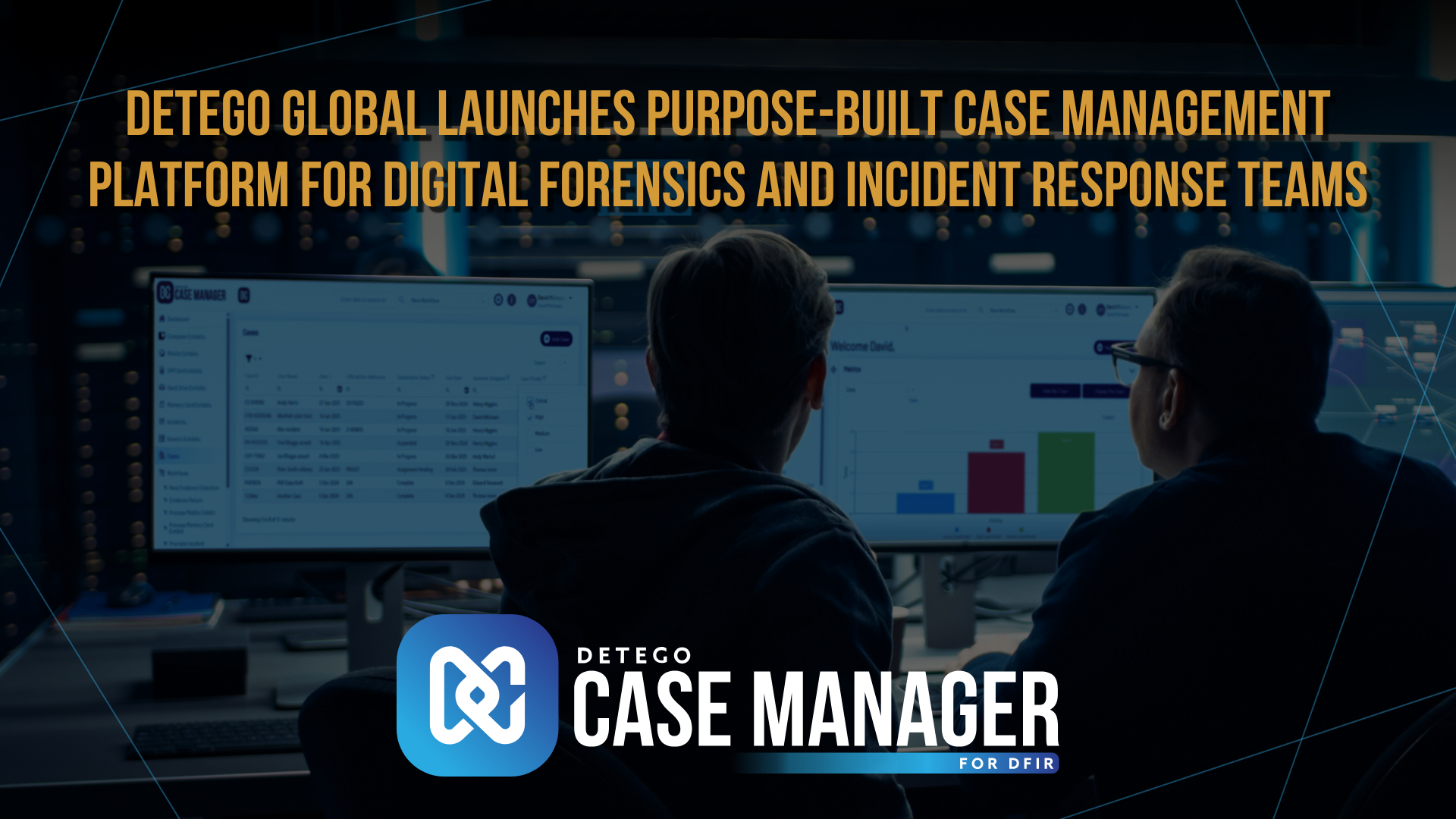
In this article, we unpack the mission behind the platform, the enabling technologies, how it fits into modern DFIR workflows, its scientific and operational significance, and the challenges digital investigators still face even with cutting‑edge tooling.
Mission Overview
At its core, the Detego Case Management Platform is designed to solve a multi‑layered problem:
- Explosive growth in digital evidence from endpoints, cloud services, IoT, and mobile devices.
- Fragmented investigation workflows spread across spreadsheets, email, and standalone forensic tools.
- Increasing legal and regulatory pressure for defensible, auditable digital evidence handling.
Detego’s stated mission with this release is to give digital forensics and incident response teams a single pane of glass for:
- Orchestrating tasks from initial triage to final reporting.
- Tracking evidence items and their chain of custody.
- Collaborating securely across teams, units, and geographies.
- Automating repetitive, error‑prone steps in investigations.
“Modern investigations live or die on how well teams manage digital evidence at scale, not just on how fast they can image a drive.”
— Paraphrased from guidance by NIST’s Information Technology Laboratory on digital forensics process maturity
In practice, this means tightly coupling case metadata, evidence artefacts, and operational playbooks. Every activity, from acquisition to analysis to reporting, is bound to a case record in a way that is both human‑readable and machine‑auditable.
Technology and Platform Architecture
The Detego Case Management Platform builds on the company’s Unified Digital Forensics Platform, which already supports imaging, triage, artifact extraction, and analytics across multiple data sources. The new layer focuses on orchestration and governance rather than raw acquisition speed.
Core Architectural Principles
- Modular microservices: Services for evidence ingestion, user management, reporting, and automation can be scaled independently.
- API‑driven integration: RESTful APIs and webhooks allow integration with SIEMs, ticketing systems, and external forensic tools.
- Role‑based access control (RBAC): Fine‑grained permissions aligned with investigative roles (examiner, incident responder, supervisor, prosecutor, etc.).
- Audit‑first design: Immutable logging of actions relevant to evidentiary integrity (who accessed what, when, and why).
Key Technical Capabilities
While Detego has not open‑sourced the underlying stack, features described in recent DFIR product briefs and industry demos suggest several advanced capabilities:
- Centralized evidence index: Hash values, timestamps, device IDs, and case tags searchable from a unified interface.
- Automated correlation: Linking artefacts (e.g., user accounts, IP addresses, file hashes) across multiple cases and devices.
- Workflow automation: Trigger‑based actions, such as automatic case creation from SIEM alerts or task assignment when new evidence arrives.
- Template‑driven reporting: Customizable templates for court reports, executive summaries, and internal post‑incident reviews.

To keep the platform responsive on mobile and low‑bandwidth environments, Detego and similar vendors typically rely on:
- Client‑side rendering optimizations and lazy loading for large evidence lists.
- Progressive enhancement, ensuring critical workflows function even on constrained devices.
- Accessible design aligned with WCAG 2.2 guidelines, enabling use by a diverse investigator base.
How It Fits into DFIR Workflows
The Case Management Platform is intended to sit on top of existing forensic and security tooling, acting as an orchestration and documentation layer rather than replacing specialized tools outright.
Typical Investigation Flow with Detego Case Management
- Alert or lead intake: A security alert (e.g., suspected ransomware, insider data theft) or law‑enforcement lead triggers case creation.
- Scoping and tasking: Investigators define scope, add related devices, stakeholders, and objectives, and assign tasks.
- Evidence collection: Using Detego’s own imaging and triage tools or third‑party applications, evidence is acquired and automatically linked to the case.
- Analysis and correlation: Artefacts are parsed, tagged, and cross‑referenced with previous cases, threat intelligence, and known‑good baselines.
- Findings review: Supervisors review key findings, verify chain of custody, and ensure that key hypotheses are tested.
- Reporting and handoff: Final reports, exhibits, and timelines are packaged for legal, HR, or executive stakeholders.
“Digital forensics is no longer a solo sport. Effective case management is the glue that holds together multidisciplinary response teams.”
— Summarized from SANS Digital Forensics & Incident Response training materials
By enforcing consistent structure across cases, Detego’s platform helps teams adopt formal DFIR methodologies such as those recommended by NIST SP 800‑86 and FIRST.
Scientific and Operational Significance
While case management might sound like a purely administrative layer, it has real scientific and evidentiary implications. Robust case management:
- Reduces cognitive load on analysts, allowing more attention on hypothesis testing and anomaly detection.
- Improves reproducibility of investigative steps, a core tenet of scientific methodology.
- Enables large‑scale analytics on investigation data — for example, identifying patterns across hundreds of cases.
DFIR as a discipline has been moving increasingly toward data‑driven methods, with pattern recognition, statistical inference, and machine learning enhancing traditional artefact examination. Platforms like Detego’s provide the structured data needed for:
- Case clustering: Grouping incidents by attacker behavior, indicators of compromise, or impacted systems.
- Timeline analytics: Quantifying typical attacker dwell time and response latency.
- Playbook optimization: Evaluating which response pathways minimize impact in particular incident classes.

“Evidence doesn’t speak for itself — investigators do. But well‑structured, well‑managed evidence gives investigators a much louder, clearer voice.”
— Rob Lee, Digital Forensics Expert and SANS Fellow (paraphrased from public DFIR talks)
By turning investigations into structured, analyzable datasets, Detego’s platform aligns with the broader evolution of security operations into a data science‑driven discipline.
Key Milestones and Ecosystem Context
The November 25, 2025 launch of the Detego Case Management Platform comes amid significant shifts in the DFIR tooling landscape:
- Rapid adoption of cloud‑native security operations platforms.
- Growing integration between EDR/XDR, SIEM, and DFIR tools.
- More stringent regulatory environments such as the EU’s NIS2 and sector‑specific cyber mandates.
Detego’s earlier unified platform already marked a milestone in bringing mobile, computer, and cloud forensics under a single umbrella. The new case management layer builds on this by:
- Completing an end‑to‑end investigative stack from triage to reporting.
- Offering cross‑case analytics and knowledge reuse.
- Providing documented, repeatable workflows for highly regulated sectors (e.g., finance, critical infrastructure).
Coverage in outlets like NextBigFuture underscores how digital forensics has moved from a niche technical subfield to a mainstream concern for national security, enterprise risk, and even consumer privacy.
Challenges and Open Questions
Even with advanced case management platforms, DFIR teams face substantial challenges.
Data Volume and Diversity
Investigations must handle:
- Petabyte‑scale logs and telemetry.
- Encrypted devices and end‑to‑end encrypted messaging.
- Cloud‑native artefacts dispersed across regions and tenants.
Case management platforms can index and track these artefacts, but they cannot fully solve cryptographic barriers or privacy‑driven data minimization by themselves.
Human Factors and Training
A powerful platform is only as effective as the people using it. Poorly configured workflows or inconsistent tagging can quickly erode the benefits of centralization.
- Investigators must understand both forensic principles and tool specifics.
- Organizations need governance policies defining who can create, edit, and close cases.
- Continuous training is required as threat landscapes and tools evolve.
Many teams rely on external certifications and training programs, such as:
- SANS FOR508: Advanced Incident Response, Threat Hunting, and Digital Forensics
- SANS DFIR community resources
Interoperability and Vendor Lock‑In
DFIR environments are notoriously heterogeneous, often combining:
- Specialist hardware imagers and write‑blockers.
- Multiple forensic suites for different artefact classes.
- In‑house scripts and automations.
While Detego’s API‑driven design is promising, long‑term success will depend on:
- Robust, documented APIs.
- Support for open standards where possible.
- Ease of data export for legal disclosure and cross‑platform analysis.
Complementary Tools and Hardware for DFIR Teams
A case management platform is one piece of a broader DFIR toolkit. Teams typically pair software like Detego with specialized hardware and reference materials.
Specialized Forensic Hardware
- Write‑blockers and imaging devices: Hardware imagers ensure that storage media can be acquired without altering original evidence. Popular field‑deployable units include devices comparable to the Tableau and Logicube families, which are often cited in DFIR training.
- Rugged forensic workstations: High‑core‑count CPUs, abundant RAM, and fast NVMe storage are essential for large‑scale artefact parsing and timeline generation.
Reference Material and Learning Aids
Practitioners commonly supplement vendor documentation with recognized DFIR texts and resources. For example:
- Intelligence-Driven Incident Response: Outwitting the Adversary – a widely used guide to building and running incident response programs.
While Detego’s Case Management Platform aims to encode best practices into workflows and templates, foundational knowledge from such texts remains invaluable for tailoring the platform to real‑world environments.

Accessibility, UX, and Mobile Responsiveness
For a global user base that includes law‑enforcement officers, corporate responders, and consultants in the field, accessibility and mobile performance are not optional.
- WCAG 2.2 alignment: Adequate color contrast, keyboard navigability, logical heading structure, and clear focus states support diverse users.
- Responsive layout: Interfaces should adapt seamlessly from large desktop monitors in labs to rugged tablets in the field.
- Efficient data visualization: Dashboards need to remain legible and performant when rendering complex case timelines and graphs.
Designing for accessibility also has operational benefits: clear navigation and predictable interactions reduce the chance of mis‑clicks, accidental evidence modification, or missed alerts during high‑stress incidents.
Conclusion
The launch of Detego Global’s Case Management Platform marks another step in the maturation of digital forensics and incident response. Where early tools focused almost exclusively on acquisition and artefact parsing, modern platforms increasingly emphasize orchestration, governance, and the science of managing evidence at scale.
By integrating case records, evidence, workflows, and reporting under one roof, Detego aims to help DFIR teams:
- Shorten investigation cycles without sacrificing rigor.
- Enhance collaboration across disciplines and jurisdictions.
- Deliver defensible, auditable outcomes in courts and boardrooms alike.
Whether this platform becomes a de‑facto standard will depend on its real‑world interoperability, usability, and ability to keep pace with ever‑evolving threat landscapes. But the direction is clear: in the age of ubiquitous data and pervasive cyber risk, effective case management is no longer a “nice to have” — it is fundamental DFIR infrastructure.
Practical Next Steps for DFIR Leaders
For organizations considering platforms like Detego’s, a practical roadmap might include:
- Baseline assessment: Map current case handling practices, tools, and bottlenecks.
- Pilot program: Run a controlled pilot on a limited set of cases, focusing on workflow realism rather than feature checklists.
- Playbook codification: Translate existing manual procedures into platform workflows and templates.
- Metrics definition: Track KPIs such as mean time to detect (MTTD), mean time to respond (MTTR), and case closure time before and after adoption.
- Continuous improvement loop: Use platform analytics to refine processes and training programs.
For a deeper dive into case‑centric approaches to DFIR, useful resources include:
- SANS DFIR White Papers
- YouTube talks on digital forensics case management
- #DFIR discussions on LinkedIn
Investing time in the design, configuration, and governance of a case management platform will often yield larger long‑term gains than adding yet another point tool to the DFIR stack.
References / Sources
- NextBigFuture – Technology and Future Trends
- Detego Global – Official Website
- NIST SP 800‑86: Guide to Integrating Forensic Techniques into Incident Response
- W3C – Web Content Accessibility Guidelines (WCAG) 2.2
- SANS DFIR – White Papers and Resources
- FIRST – Forum of Incident Response and Security Teams
