
4 Daily Core Moves That Tame Belly Overhang After 60 (Without Living at the Gym)
If you’re over 60 and noticing more “belly overhang” than you’d like, you’re not alone. Many of my older clients used to think the only answer was hours of crunches or exhausting gym sessions. In reality, a handful of smart daily exercises that target your deep core can do more for your midsection than most long workouts—especially when paired with gentle walking and healthy eating.
Below, you’ll learn four daily core exercises that are joint-friendly, accessible, and designed with adults over 60 in mind. They won’t magically erase belly fat overnight (nothing honest will), but they will help firm the muscles underneath, support your spine, improve posture, and make clothes fit and feel better.
Why Belly Overhang Becomes So Stubborn After 60
As we age, several changes make belly overhang more common:
- Slower metabolism: We burn fewer calories at rest, so extra energy is more likely to be stored as fat around the midsection.
- Hormonal shifts: For many, lower estrogen or testosterone levels encourage fat to collect around the abdomen.
- Muscle loss (sarcopenia): Without strength training, we lose muscle, especially in the core and hips, reducing support for the belly.
- Posture changes: Rounded shoulders and a tilted pelvis can make belly overhang look and feel worse.
You can’t “spot reduce” fat from the belly with exercise alone, but you can firm and lift the area by strengthening the muscles that act like an internal corset—the deep core.
The Science: Why Deep Core Exercises Beat Endless Crunches
Research in older adults consistently shows that core stability training improves balance, reduces back pain, and enhances functional strength more effectively than traditional sit-ups or crunches. Deep core muscles like the transverse abdominis and multifidus wrap around your midsection like a natural “weight belt”.
- Studies in journals such as Spine and the Journal of Orthopaedic & Sports Physical Therapy associate deep-core activation with reduced low back pain and better posture.
- Better posture and spinal alignment can make the abdomen appear flatter—even before any visible fat loss.
“For older adults, core stability and hip strength are often more important than raw abdominal muscle power. They influence balance, walking, and how the abdomen ‘sits’ on the body.” — Adapted from clinical exercise physiology findings
The four exercises below emphasize this kind of stability and deep activation rather than fast, jerky movements.
Overview: The 4 Daily Moves to Firm Belly Overhang After 60
You can do these four exercises at home in under 15 minutes:
- Seated or Supine Deep Belly Bracing (Transverse Abdominis Activation)
- Modified Dead Bug
- Alternating Superman or Bird Dog
- Supported Glute Bridge
Aim to perform them:
- Frequency: 5–7 days per week, if comfortable
- Intensity: Gentle to moderate; you should feel muscles working without pain or breathlessness
- Time: 10–15 minutes total
Move 1: Deep Belly Bracing – Your “Internal Corset” Exercise
Deep belly bracing teaches you to engage the transverse abdominis—often called the “corset muscle.” It’s subtle but powerful, and it sets the foundation for every other move.
How to do it (supine version)
- Lie on your back with knees bent, feet flat, and arms by your sides.
- Place one hand on your lower belly, just below the navel.
- Breathe in gently through your nose, letting your belly rise.
- As you exhale, gently draw your lower belly toward your spine as if tightening a loose belt one notch. Do not hold your breath.
- Hold this gentle brace for 5–10 seconds while breathing lightly, then relax.
- Repeat for 8–12 reps.
Chair variation (if getting down to the floor is hard)
- Sit tall on a sturdy chair, feet flat, hands on lower belly.
- Perform the same gentle “belt tightening” with your exhale.
- Hold 5 seconds, relax 5 seconds; repeat 8–12 times.
Move 2: Modified Dead Bug – Training Core Stability Without Strain
The modified dead bug challenges your core to stay steady while your arms and legs move. This is excellent for reducing wobble and building a firm, supportive midsection.
How to do it
- Lie on your back with knees bent and feet flat. Brace your core gently (as in Move 1).
- Lift one leg so your knee is above your hip and your shin is parallel to the floor.
- Lift the opposite arm straight up toward the ceiling.
- Slowly lower the arm and leg toward the floor (only as far as you can go without your lower back arching off the mat).
- Return to the starting position with control.
- Perform 8–10 repetitions on one side, then switch.
Easier variation
- Keep your foot lightly touching the floor and slide the heel away instead of lifting the whole leg.
- Move only the arms at first, then add legs when you feel more stable.
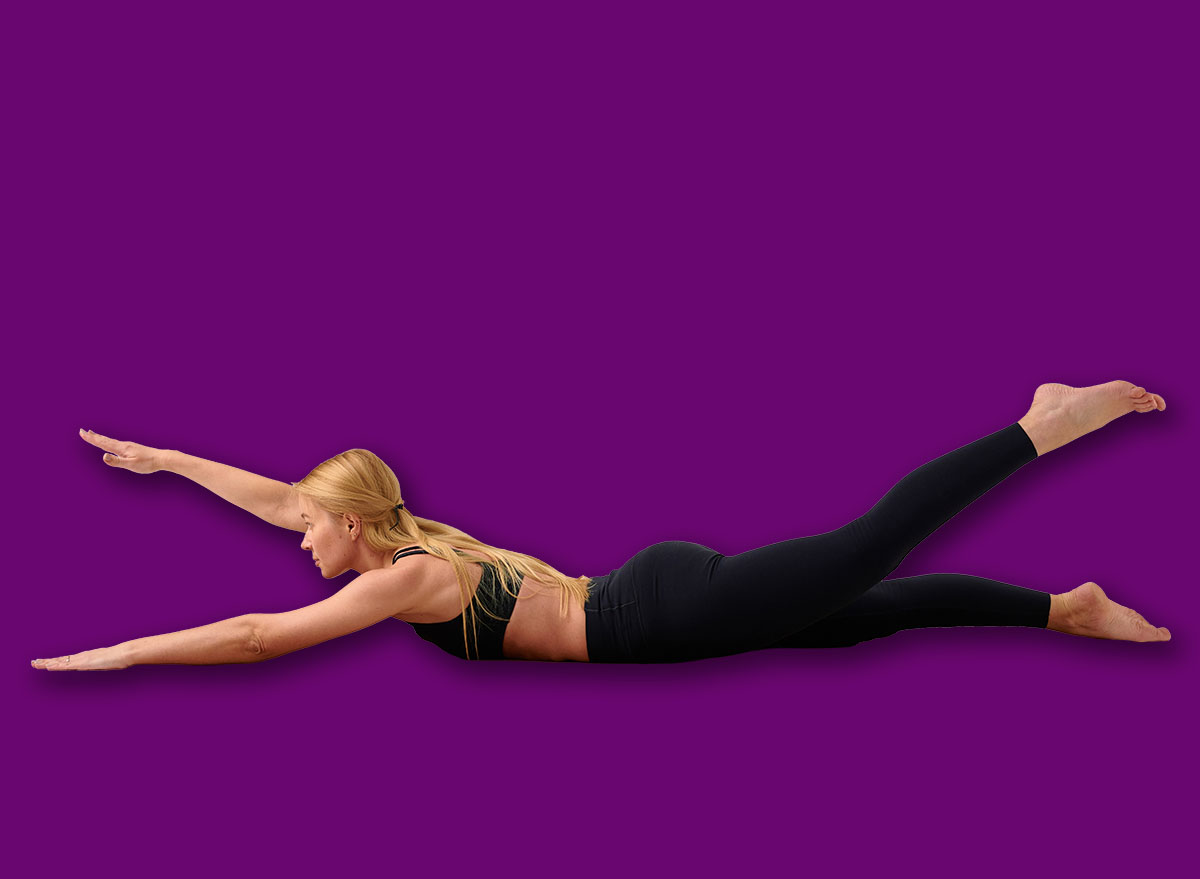
Move 3: Alternating Superman or Bird Dog – Strengthen the Back of Your Core
Belly overhang isn’t just about the front of your body. The muscles along your back and glutes also play a major role in how your stomach looks and feels. A stronger backside naturally pulls you into taller posture, giving the belly less room to spill forward.
Bird dog (joint-friendly option)
- Start on hands and knees, wrists under shoulders, knees under hips. Keep your spine neutral.
- Brace your core gently.
- Extend your right leg straight back behind you while reaching your left arm forward.
- Hold for 3–5 seconds, imagining a straight line from fingertips to heel.
- Return to start and switch sides.
- Do 6–10 repetitions per side.
Alternating superman (if comfortable lying on your stomach)
- Lie face down with arms reaching overhead and legs straight.
- Lift your right arm and left leg a few inches off the floor, keeping your neck neutral.
- Hold 3 seconds, lower, then switch sides.
- Aim for 8–12 total alternating reps.
Move 4: Supported Glute Bridge – Lifting the Hips to Help the Belly

The glute bridge strengthens your glutes and hamstrings, helping align your pelvis. This can reduce the “forward tilt” that often exaggerates belly overhang.
How to do it
- Lie on your back with knees bent and feet hip-width apart, fairly close to your hips.
- Brace your core gently and press your arms into the floor for support.
- Press through your heels to lift your hips until your body forms a straight line from shoulders to knees.
- Pause at the top for 2–3 seconds, squeezing the glutes (not your lower back).
- Lower slowly and repeat for 10–12 reps.
Support and modifications
- Place a cushion or folded blanket under your head if your neck feels strained.
- If full bridges are hard, start with a mini-bridge, lifting your hips just a few inches off the floor.
- Rest for 30–45 seconds after each set; aim for 1–3 sets depending on your fitness level.
Daily Core Routine vs. Traditional Gym Workouts: What’s More Effective After 60?

Long, intense gym workouts can certainly burn calories, but they’re not always realistic or joint-friendly after 60. What tends to work better for many older adults is:
- Consistency over intensity: 10–15 minutes a day, most days, often beats one hard workout per week.
- Function over fatigue: Exercises that help you stand taller, walk easier, and feel steadier are more sustainable.
- Recovery-friendly: Gentle core work creates less soreness and joint stress, so you’re more likely to keep doing it.
Over a few months, my clients who commit to short daily routines often notice:
- Less lower-back stiffness in the morning.
- Clothes fitting a bit looser around the waist.
- Easier balance when walking or climbing stairs.
One of my 68-year-old clients started with just these four moves and a 10-minute daily walk. Three months later, she reported her “apron belly” felt lighter, she could stand longer in the kitchen, and her back stopped “catching” when she turned.
How to Put It All Together: A 15-Minute Daily Belly-Firming Routine
Here’s a simple way to structure these four exercises into a daily practice:
- Warm-up (2–3 minutes)
- March in place or walk around your home.
- Gently roll your shoulders and circle your hips.
- Core circuit (10–12 minutes)
- Move 1: Deep Belly Bracing – 8–12 reps
- Move 2: Modified Dead Bug – 8–10 reps per side
- Move 3: Bird Dog or Alternating Superman – 6–10 reps per side
- Move 4: Supported Glute Bridge – 10–12 reps
Rest 30–60 seconds between moves. Repeat the circuit 1–2 times, depending on how you feel.
- Cool-down (2–3 minutes)
- Gentle cat–cow stretches on hands and knees or seated spinal twists in a chair.
- Slow, deep breathing to relax your nervous system.
Common Obstacles After 60—and How to Work Around Them
Real life rarely looks like a fitness commercial. Here are some common roadblocks my older clients face, plus practical ways around them:
1. “My knees and back hurt.”
- Use the chair variations for deep bracing and gentle marches to start.
- Place extra padding (yoga mat, folded blankets) under your joints.
- Stay within a pain-free range; mild muscle effort is fine, sharp joint pain is not.
2. “I get discouraged when I don’t see the scale move.”
- Track non-scale victories: better balance, easier walking, less back stiffness, improved mood.
- Notice how your posture and confidence feel in the mirror, not just your waistline.
3. “I’m afraid I’ll do it wrong.”
- Focus on slow, controlled movement. Rushing is when form usually falls apart.
- If possible, have a friend or family member watch a demonstration video from a reputable source (like a physical therapy clinic or certified trainer) and compare.
Safety First: When to Talk to Your Doctor or Physical Therapist
While these exercises are generally low-impact and appropriate for many adults over 60, it’s important to stay on the safe side—especially if you have health conditions.
- Consult your healthcare provider before starting if you have:
- Recent surgery (especially abdominal, back, or hip surgery)
- Uncontrolled high blood pressure or heart disease
- Severe osteoporosis or history of spinal fractures
- Stop and seek guidance if you experience:
- Sharp or radiating pain
- Chest pain or severe shortness of breath
- Numbness, tingling, or weakness in your legs
A few sessions with a physical therapist or certified trainer experienced with older adults can be a worthwhile investment to check your form and tailor the moves to your body.
Beyond Exercise: Habits That Help Belly Overhang After 60
Exercises like these are most effective when combined with gentle, sustainable lifestyle changes. A few that matter:
- Daily walking: Even 10–20 minutes a day can support heart health, mood, and gradual fat loss.
- Protein at each meal: Helps preserve muscle as you age. Think eggs, Greek yogurt, beans, fish, or lean meats.
- Sleep and stress management: Poor sleep and constant stress are linked with increased belly fat and cravings.
- Hydration: Drinking enough water can help digestion and reduce bloating that makes the belly feel heavier.
None of these have to be perfect. Small improvements—like adding a 10-minute walk or an extra serving of vegetables—can reinforce the work you’re doing with your core.
Bringing It All Together: Start Small, Stay Steady
Firming a stubborn belly overhang after 60 isn’t about perfection or punishing workouts. It’s about teaching your body to support you from the inside out—through deep core strength, better posture, and steady, realistic habits.
You don’t have to change everything overnight. For the next week, try this:
- Pick two of the four moves and do them daily.
- Add a 5–10 minute walk most days.
- Notice how your body feels—less stiff, a bit stronger, maybe a touch more confident.
When that feels manageable, add the remaining exercises or a second round. Your belly didn’t change overnight, and it won’t change back overnight—but consistent, thoughtful movement can absolutely reshape how your midsection feels and functions at any age.
Your next step: choose a time tomorrow—morning, lunchtime, or evening—and schedule your first 10-minute core session. Treat it as an appointment with your future, stronger self.
