
How a Brain Implant Gave an ALS Patient His Voice Back — and What This Breakthrough Means for the Future
The first time Casey Harrell’s new voice reached his daughter, the room went completely still. After ALS took away his ability to speak, his words had lived only in memories and old recordings. But thanks to a groundbreaking brain implant, he was suddenly able to tell his daughter “I love you” again — not by moving his lips or pressing a switch, but simply by thinking the words.
This isn’t science fiction. It’s the emerging reality of brain–computer interfaces (BCIs) for people living with ALS, stroke, and other conditions that steal speech. In this article, we’ll unpack what happened in Casey’s case as reported by the San Francisco Chronicle, how this new technology actually works, what it can and can’t do yet, and what families coping with ALS can realistically expect in the coming years.
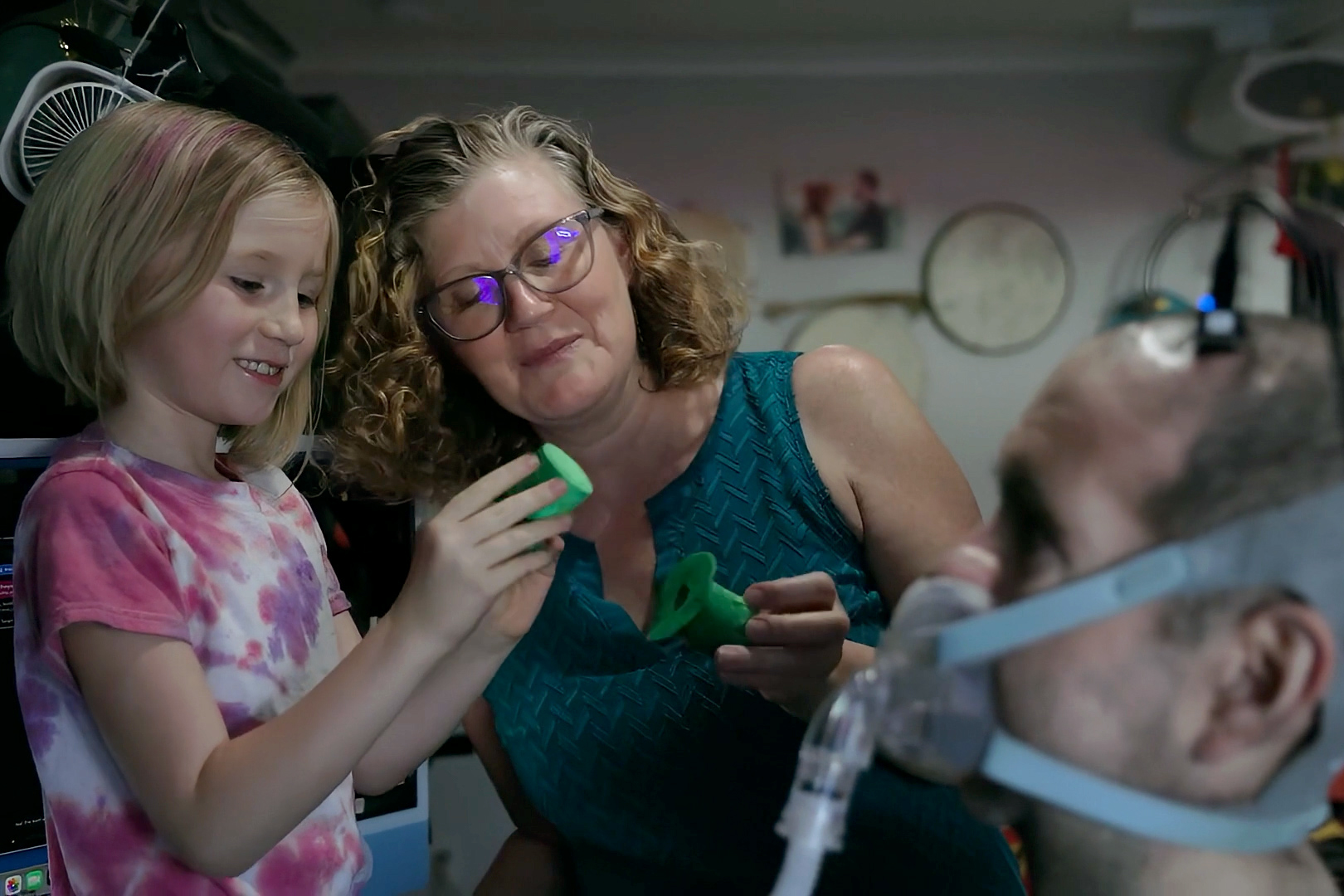
“When I heard him talk to our daughter again, it felt like getting a piece of our life back. It’s not perfect, but it’s ours.” — Family account shared in coverage of Casey’s story
When ALS Takes a Voice: The Emotional and Practical Reality
Amyotrophic lateral sclerosis (ALS) gradually damages the nerve cells that control movement. For many people, that includes the muscles needed for speech — the tongue, lips, and vocal cords. Over time, even forming simple sounds becomes exhausting or impossible.
Losing speech isn’t just a medical problem; it reshapes relationships. Parents can’t read bedtime stories the way they used to, partners lose the comfort of casual conversation, and everyday tasks — like ordering food or asking for help — suddenly require planning and technology.
- Emotionally, many people describe a sense of “disappearing” from conversations.
- Socially, talking becomes slower, so others may unintentionally talk over or around them.
- Practically, families need to learn new tools, from communication boards to eye-tracking devices.
How a Brain Implant Can Help Someone “Speak” Again
In Casey Harrell’s case, researchers placed a small grid of electrodes on the surface of his brain, in the region that normally controls the muscles for speech. This device doesn’t restore those muscles; instead, it listens directly to the brain activity that would have driven them.
- Thinking about speaking
Casey imagines saying words or moving his mouth, just as he did before ALS affected his speech. - Brain signals are recorded
The implant detects patterns of electrical activity in the speech area of his brain. - Signals are decoded by AI
Advanced software, often using machine learning, interprets those patterns to guess which sounds, words, or letters he intends. - Words are spoken aloud
The system sends the decoded message to a computer or tablet, which can display text or generate synthesized speech.
Recent peer‑reviewed studies, including work from research teams at UCSF and Stanford (published in journals such as Nature and New England Journal of Medicine), have shown that these systems can reach impressive speeds — sometimes over 60–70 words per minute under research conditions. However, real‑world performance can be slower and less accurate, and systems often require extensive training time.

“These devices don’t ‘read minds’ in a sci‑fi sense. They decode very specific patterns related to attempted movements or speech and translate them into digital signals.” — Neuroengineering researcher, summarizing current BCI science
Inside Casey’s Journey: From Silence to a New Kind of Conversation
According to the San Francisco Chronicle’s reporting, Casey reached the brain implant trial at one of the darkest points in his ALS journey. Traditional tools like text‑to‑speech devices and eye‑tracking helped, but they were slow and fatiguing. He wanted a way to keep up with his wife, Levana, and his daughter, Aya, in “real time” again.
Joining an experimental trial is a courageous decision. It typically involves surgery, intense training sessions, and the emotional weight of knowing that things may or may not work as hoped. Yet for some families, the possibility of regaining even fragments of natural conversation outweighs those risks.
- Before the implant: Communication relied mostly on eye‑gaze technology and assistive tablets.
- After the implant: He could generate words and phrases by imagining speech, allowing more fluid back‑and‑forth with family members.
- Everyday impact: Jokes, small talk, and spontaneous “I love yous” became more possible again, even if the system still made errors.
What This Brain Implant Technology Can — and Cannot — Do (Yet)
Stories like Casey’s can be incredibly hopeful, but they can also create understandable confusion about what’s possible today. Here’s a grounded look at current capabilities, based on recent research and clinical experiences.
Current strengths
- Restoring basic conversation for research participants who cannot speak due to paralysis or severe ALS.
- Higher potential speed than many traditional assistive communication methods, especially for those with limited motor control.
- Hands‑free and eye‑free use, which can be critical when eye movement also becomes difficult.
Current limitations
- Experimental status: These systems are not yet widely available as approved medical devices.
- Surgical risks: Implantation requires brain surgery, with associated risks like infection or bleeding.
- Training time: Users and systems both need many hours of practice for the algorithms to learn individual brain patterns.
- Accuracy and fatigue: Mis‑decoded words, signal drift, and user fatigue are still common challenges.

“We’re in the early chapters of a long story. The technology is extraordinary, but so is the patience and resilience of the people using it.” — Clinician involved in BCI research
If Your Family Is Facing ALS: Practical Steps for Communication Now
Even if a brain implant isn’t available or right for you, there is a spectrum of proven tools that can make communication easier and more dignified. Many families use a blend of low‑tech and high‑tech solutions.
1. Start planning early
- Ask your neurologist for a referral to a speech‑language pathologist (SLP) experienced in ALS.
- Discuss options like voice banking (recording phrases while speech is still strong) for later use in synthetic voices.
2. Explore available assistive technologies
- Low‑tech: Communication boards, letter boards, yes/no cards.
- Mid‑tech: Simple speech‑generating devices or smartphone apps.
- High‑tech: Eye‑tracking systems, switch‑activated computers, and text‑to‑speech software.
3. Talk with your care team about research opportunities
If you’re interested in experimental options like brain–computer interfaces:
- Ask your ALS clinic whether they’re connected to BCI research centers or can refer you.
- Review any trial carefully, including eligibility criteria, time commitments, and risks.
- Consider having a family meeting with your physician to discuss expectations and practicalities.
Common Obstacles — and How Families Work Through Them
Even the best technology comes with real‑life friction. Families like Casey’s often describe a mix of hope, frustration, and adjustment as they learn new ways to talk with each other.
1. Technology fatigue
Using any communication system — from eye‑tracking to brain implants — can be mentally and physically tiring.
- Build in short, regular breaks during longer conversations.
- Use quick‑access phrases for common needs (“I’m uncomfortable,” “Please adjust my position,” “I need a break”).
2. Emotional ups and downs
It’s normal to feel grief about the loss of natural speech even while celebrating technological gains.
- Consider counseling or support groups for both the person with ALS and caregivers.
- Make space for non‑goal‑oriented conversations — not just “needs” but stories, memories, and dreams.
3. Accessibility and cost
Not all devices, especially experimental implants, are covered by insurance or available nearby.
- Work with a social worker or case manager at your ALS clinic to explore funding options.
- Ask about loaner programs for devices while you test what works best.

Looking Ahead: A Future Where Thought Can Become Speech
Casey’s experience is part of a rapidly evolving field. Researchers are working on:
- Smaller, less invasive implants that could reduce surgical risk.
- Wireless systems that don’t require bulky cables.
- Better AI decoding that adapts to changes in brain signals over time.
- Personalized synthetic voices that sound more like the person’s original voice.

For now, though, the most important message from stories like Casey’s may be this: even when ALS takes away a voice, it does not erase a person. Technology — from simple alphabet boards to sophisticated brain implants — is at its best when it helps families stay connected to the humor, wisdom, and love that were always there.
If your family is navigating ALS or another condition that affects speech, consider this your gentle nudge to take one concrete step this week: schedule a conversation with your care team about communication tools, explore a reputable ALS resource, or sit down together to talk honestly about hopes and fears. Every small step you take now can make tomorrow’s conversations a little easier.
