
Why We Risk Everything for Space: From Project Hail Mary to Artemis II
Why Human Spaceflight Still Captivates Us in a Dangerous Universe
Space travel is extraordinarily dangerous, yet missions like Artemis II and stories like Andy Weir’s Project Hail Mary continue to grip our imagination. At first glance, it seems irrational: when robotic spacecraft can travel farther and endure more, why do we keep putting people on the rocket?
The answer lies in a mix of hard science and very human psychology. Astronauts can still do things robots struggle with, and—equally important—people care more deeply when other people are on the line. That emotional connection fuels funding, innovation, and public support in ways no rover selfie ever quite matches.
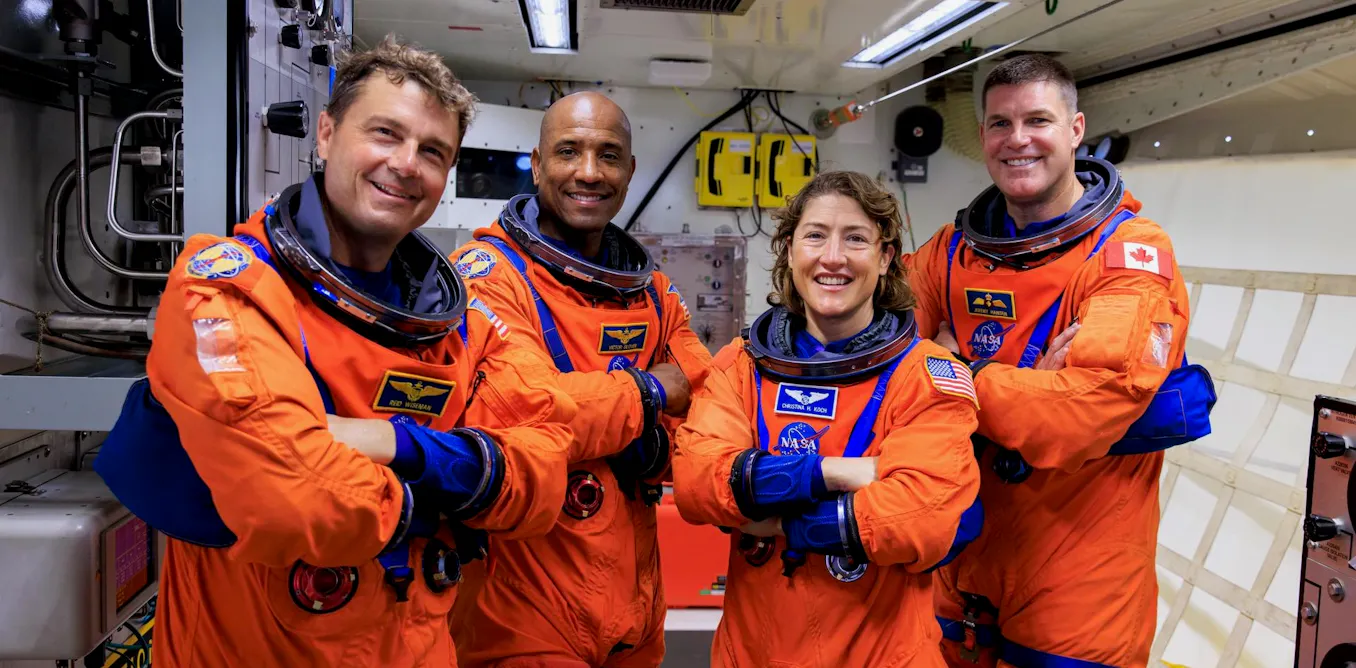
This page explores why human spaceflight is so hazardous, how it compares with robotic exploration, and why centering people—whether on the screen in Project Hail Mary or inside Orion on Artemis II—still matters for science, technology, and culture.
The Real Problem: Space Is Lethal, and Humans Are Fragile
It’s easy to forget, watching glossy launch videos, that space is fundamentally hostile to life. A human can survive:
- Seconds without pressure before losing consciousness
- Minutes without oxygen before permanent brain damage
- Only tightly limited doses of cosmic radiation over a lifetime
Every crewed mission is a carefully managed dive into an environment where:
- Vacuum will boil fluids and rupture lungs.
- Radiation from solar storms and galactic cosmic rays can damage DNA and increase cancer risk.
- Microgravity erodes bones, weakens muscles, and changes cardiovascular function.
- Extreme temperatures swing hundreds of degrees between light and shadow.
The core challenge is simple but unforgiving: to keep a small bubble of Earth-like conditions intact while hurtling through vacuum at thousands of meters per second, with almost no margin for error.
From Apollo to Artemis II: How Risk Is Managed, Not Eliminated
Historically, every major leap in human spaceflight—Mercury, Gemini, Apollo, Shuttle, and now Artemis—has demanded that astronauts accept serious risk. What has changed is how systematically that risk is analyzed and mitigated.
Key Ways Artemis II Improves on Earlier Eras
- Improved launch escape systems: The Orion spacecraft rides with a powerful abort system designed to pull the crew capsule away from a failing rocket in milliseconds.
- More fault-tolerant electronics: Modern avionics use radiation-hardened components and redundancy so that single-point failures are minimized.
- Better life support monitoring: Sensors continuously track atmosphere, pressure, CO₂, and temperature, feeding into automated safety responses.
- Data from decades in low Earth orbit: International Space Station research has mapped how human bodies react to long-duration spaceflight, guiding medical protocols and training.

“Risk is inherent in all human spaceflight. Our job is to understand it, reduce it where we can, and be honest about what remains.”
— Adapted from NASA human-rating philosophy
Even so, Artemis II—the first crewed mission to fly around the Moon since Apollo—is not “safe” in any everyday sense. It’s a measured gamble, informed by experience and backed by layers of engineering safeguards, but it remains a high-consequence endeavor.
Robots vs. Humans: Why Put People in Harm’s Way?
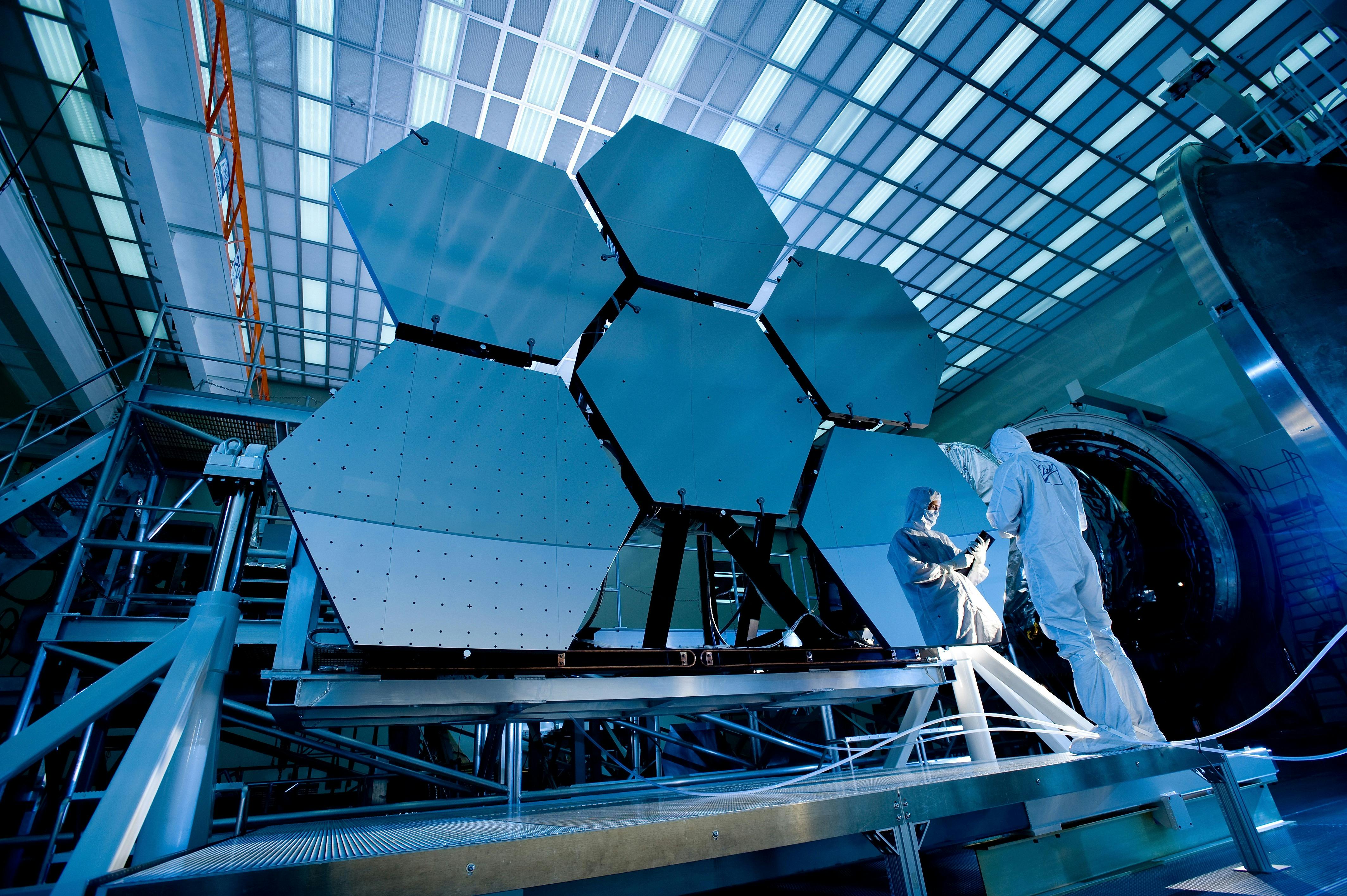
Robotic spacecraft have transformed planetary science. Missions like Voyager, Mars rovers, and the James Webb Space Telescope have gone places humans can’t yet reach, at far lower direct risk. Technically, robots are ideal for:
- Extreme environments (Venus, outer planets, high-radiation belts)
- Long-duration missions (decades in deep space)
- Tasks requiring ultra-precise, repetitive measurements
Yet there are compelling reasons why humans still matter in space.
What Humans Still Do Better
- Rapid problem solving: Astronauts can improvise repairs and reconfigure equipment in ways that would be nearly impossible to pre-program. Apollo 13 is the classic example.
- On-the-spot judgment: Geologists on the Moon could choose more interesting rock samples in minutes than a rover might in days.
- Complex construction and maintenance: The International Space Station exists because people assembled, repaired, and upgraded it across hundreds of spacewalks.
Technically, then, humans are still competitive in some niches. But the deeper reason we send people is emotional and political: societies are simply more willing to fund and follow missions that have a human face.
Why Stories Like “Project Hail Mary” and Missions Like Artemis II Stick With Us
The film and novel Project Hail Mary center on a desperate, near-impossible mission to save humanity from a cosmic threat. While the scenario is fiction, the emotional architecture is familiar: one vulnerable human, staggering odds, and a stark choice between retreat and courage.
Artemis II tells a quieter version of that same story. There is no alien microbe dimming the Sun, but there is a crew leaving the safety of low Earth orbit, relying on a new spacecraft and systems that have not yet been tested with people on board.
Three Reasons Human-Centered Space Stories Resonate
- Identity: When we watch astronauts, we’re really watching a possible version of ourselves. Their fears and hopes mirror our own.
- High stakes: The knowledge that real lives—and in fiction, sometimes all life—are at risk heightens our emotional engagement.
- Symbolism: Space becomes a canvas for our biggest questions: Why are we here? What is worth risking everything for?

Storytellers lean into these themes because they work. Space agencies lean into them because public support often depends on whether people feel emotionally invested—not just in the data, but in the humans who gather it.
Tangible Benefits: What Human Spaceflight Actually Gives Us
It’s fair to ask whether the risk and expense of crewed missions are justified. While not every claim about “spinoffs” holds up, several categories of benefit are well documented.
1. Technology and Engineering Advances
- Improvements in materials science, lightweight alloys, and heat shields
- More reliable life-support and water recycling technologies
- Enhanced robotics and teleoperation systems used in surgery and industry
2. Earth and Space Science
- Better climate and Earth-observation data via crewed platforms
- Human-conducted experiments in microgravity, informing medicine and biology
- In-situ geological work (e.g., Apollo) that still shapes lunar science
3. Societal and Educational Impacts
- Inspiration that draws students into STEM careers
- International collaboration and diplomacy on large-scale projects
- Shared cultural moments that reinforce a sense of global perspective
“Exploration is in our nature. We began as wanderers, and we are wanderers still.”
— Carl Sagan
None of this means that every mission pays off equally, nor that crewed spaceflight is the only—or even always the best—path to these benefits. But the record shows that sustained human programs tend to leave behind rich scientific, technological, and cultural legacies.
Common Concerns About Human Spaceflight—and How They’re Addressed
Many people are understandably skeptical about the push to send humans deeper into space. Three objections come up again and again.
“Shouldn’t We Fix Earth First?”
Space budgets are often overestimated in public debate. For many countries, human spaceflight consumes a tiny fraction of national spending—far less than major social programs or defense. Meanwhile, Earth-observing satellites and space-derived technologies directly support climate monitoring, disaster response, and communications.
“Isn’t It Ethically Wrong to Expose Astronauts to Such Risk?”
Astronauts are volunteers who undergo extensive screening and training, fully informed of the dangers. Modern space agencies use ethical review processes, strict medical standards, and continuous safety assessments to ensure that risk is justified and transparent.
“Won’t AI and Advanced Robotics Make Astronauts Obsolete?”
AI and robotics will certainly shift the balance between crewed and uncrewed missions. But even very advanced systems are likely to benefit from humans “in the loop”—especially in early stages of off-world construction, resource use, and settlement. Rather than replacing astronauts, smarter machines may become their most trusted partners.
A Case Study in Human-Centered Exploration: A Researcher’s Perspective
Consider a planetary scientist who has spent a career working with robotic missions—Mars rovers, lunar orbiters, asteroid probes. On paper, these missions are models of efficiency. They deliver vast amounts of data, never get tired, and don’t require life support.
Yet many such scientists quietly admit that their most powerful outreach moments come when they can point to a human being in a spacecraft window, or on a spacewalk, and say to a classroom of students, “Someone just like you is up there doing this work.”
“The day we watched a live spacewalk with our students, applications to our school’s STEM program doubled the following year. It wasn’t the data that moved them—it was the people.”
— Anecdote from a secondary-school science teacher
In this way, human spaceflight acts as a multiplier: it not only generates science, but also the future scientists, engineers, and informed citizens who will decide what we dare to do next.
How You Can Thoughtfully Engage With Human Spaceflight
You don’t need to be an astronaut—or even a scientist—to take part in the conversation about our future in space. A few practical ways to engage:
- Follow diverse sources: Balance agency press releases with independent journalism and commentary that critically assess mission risks and benefits.
- Support evidence-based policy: When space issues appear on ballots or in public debate, look for proposals rooted in transparent risk assessment and peer-reviewed science.
- Use space stories in education: Parents and teachers can leverage missions like Artemis II or stories like Project Hail Mary to spark discussion about physics, ethics, and global cooperation.
- Participate in citizen science: Projects linked to astronomy and planetary science often welcome public participation in data classification and observation.
Looking Ahead: Humans, Robots, and the Next Chapter of Exploration
As technology advances toward the late 2020s and 2030s, the sharp line between “human missions” and “robotic missions” will blur. Astronauts on or around the Moon may oversee swarms of autonomous machines; crews headed for Mars will likely rely on AI-driven navigation and health monitoring in ways that echo, but don’t replicate, the fictional tools in Project Hail Mary.
What’s unlikely to change is the centrality of people—both in spacecraft and on the ground. We respond, viscerally, to stories of humans facing down an indifferent universe, whether they are fictional scientists drifting alone between the stars or real crews strapping in for a loop around the Moon.
As you watch the next launch, or turn the last page of the next great space novel, you might ask yourself:
- What risks are we, as a species, willing to take in pursuit of knowledge?
- How do we balance exploration with responsibility—to astronauts, to taxpayers, and to our planet?
- And what kind of future in space feels both bold and humane to you?
Human spaceflight will never be truly safe. But by keeping people—and their stories—at the heart of exploration, we give ourselves a chance to face that danger with open eyes, shared purpose, and a clearer sense of why we go at all.
Your role might not be piloting a spacecraft, but it can be just as important: asking hard questions, insisting on evidence, and keeping the human story at the center of our push into the cosmos.
Article Metadata (SEO & Structured Data)
Meta Title: Why Human Spaceflight Still Matters: From Project Hail Mary to Artemis II
Meta Description: Space is extremely dangerous, yet missions like Artemis II and stories like Project Hail Mary continue to captivate us. Explore the real risks of human spaceflight, how it compares with robotic exploration, and why putting people in space still matters for science, technology, and public imagination.
