
How Perovskite–Silicon Tandem Solar Cells Are Smashing Efficiency Records
Perovskite–silicon tandem solar cells have moved from lab curiosity to front‑runner status in the race for ultra‑high‑efficiency photovoltaics. Over the past few years, certified efficiencies have surged from the low‑20% range to beyond 33% in leading laboratories, edging closer to the theoretical limits of two‑junction devices. This leap is fueled by sophisticated chemistry, precision interface engineering, and aggressive industrial scale‑up efforts from startups and major solar manufacturers alike.
At the same time, record announcements and pilot‑line rollouts are triggering waves of coverage across science journals, green‑energy media, YouTube explainer channels, and professional networks such as LinkedIn. Interest spikes around keywords like “perovskite tandem solar cells,” “next‑gen PV,” and “perovskite stability,” reflecting a growing consensus: if stability and durability hurdles can be solved, perovskite–silicon tandems could redefine the economics and deployment speed of solar power.
Mission Overview: Why Perovskite–Silicon Tandems Matter
Conventional crystalline silicon (c‑Si) solar cells dominate today’s market, accounting for over 90% of global PV deployment. However, single‑junction silicon devices are bumping against a practical efficiency ceiling of roughly 26–27% in the lab and ~24–25% in commercial modules, constrained by the Shockley–Queisser limit and non‑idealities in real manufacturing.
Perovskite–silicon tandem cells aim to break through that ceiling by stacking two light‑absorbing materials with complementary bandgaps in series. A wide‑bandgap perovskite top cell harvests high‑energy visible photons, while the silicon bottom cell captures lower‑energy red and near‑infrared light. This improved spectral utilization enables theoretical efficiencies beyond 40% and practical module targets above 30%, significantly boosting energy yield per square meter.
- Top cell: metal‑halide perovskite with tunable bandgap (typically ~1.68–1.80 eV for tandems).
- Bottom cell: high‑quality c‑Si cell, often PERC, TOPCon, or heterojunction (HJT) architecture.
- Configuration: monolithic (2‑terminal) tandems are currently the main industrial focus.
“Tandem architectures—especially perovskite on silicon—represent one of the few realistic paths to significantly higher PV efficiencies using scalable manufacturing.” — National Renewable Energy Laboratory (NREL) researchers
Materials Background: What Makes Perovskites Special?
Perovskites are a broad class of materials defined by the ABX3 crystal structure, where A and B are cations and X is an anion (often a halide). In metal‑halide perovskites used for solar cells, A is typically an organic cation (e.g., methylammonium, formamidinium) or inorganic cation (e.g., cesium), B is a metal such as lead (Pb) or tin (Sn), and X is a halide (Cl, Br, I).
These compounds exhibit a remarkable combination of properties:
- Strong and broadband light absorption with high absorption coefficients.
- Long carrier diffusion lengths and low non‑radiative recombination.
- Tunable bandgaps via compositional engineering (ionic substitution and mixing).
- Solution processability, enabling low‑temperature, large‑area coating techniques.
For tandem integration, researchers design perovskites with bandgaps around 1.68–1.8 eV, commonly using mixed cations (FA, Cs) and mixed halides (I/Br) to balance absorption, stability, and lattice properties. This top‑cell bandgap is carefully optimized relative to silicon’s ~1.12 eV bandgap to maximize current matching in monolithic two‑terminal designs.
Technology: Device Architectures and Manufacturing Pathways
The rapid progress in perovskite–silicon tandem efficiency is closely tied to innovations in device architecture, interfacial layers, and scalable deposition methods. Modern tandems must deliver not only high power conversion efficiency (PCE) but also industrial viability—compatibility with existing silicon lines, reasonable throughput, and robust encapsulation.
Monolithic (2‑Terminal) vs. Mechanically Stacked (4‑Terminal)
Two main architectures are pursued:
- Monolithic (2T) tandems share a common series connection and are fabricated as a single integrated device on top of a silicon wafer or cell. They offer:
- Higher potential efficiency at the module level due to fewer optical and wiring losses.
- Lower balance‑of‑system costs thanks to similar system design as standard silicon modules.
- Greater manufacturing complexity, requiring tight current matching between sub‑cells.
- Mechanically stacked (4T) tandems combine two electrically independent sub‑modules. They allow independent optimization of each cell and more flexible bandgap combinations but tend to be more complex and costly in terms of optics and connections.
Key Layers in a Monolithic Perovskite–Silicon Tandem
- Transparent conductive oxide (TCO) front electrode (e.g., indium tin oxide, ITO).
- Electron transport layer (ETL) such as SnO2 or TiO2.
- Perovskite absorber tuned for wide bandgap (~1.7 eV).
- Hole transport layer (HTL), e.g., Spiro‑OMeTAD, PTAA, or doped polymers.
- Recombination layer (interconnection layer) between perovskite and silicon cells.
- Silicon bottom cell (PERC, TOPCon, HJT) with its own passivation and contacts.
Manufacturing and Scale‑Up
Several deposition strategies are being pursued for large‑area tandems:
- Slot‑die coating and blade coating for continuous, roll‑compatible processes.
- Vapor deposition (thermal evaporation, hybrid CVD) for precise thickness and uniformity.
- Inkjet printing and spray coating for patternable, low‑waste manufacturing.
Large manufacturers and startups, including entities like Oxford PV and several major Chinese and European PV firms, have announced pilot lines targeting perovskite‑on‑silicon tandem modules with efficiencies above 28–30% and warranties aligned with conventional silicon modules.
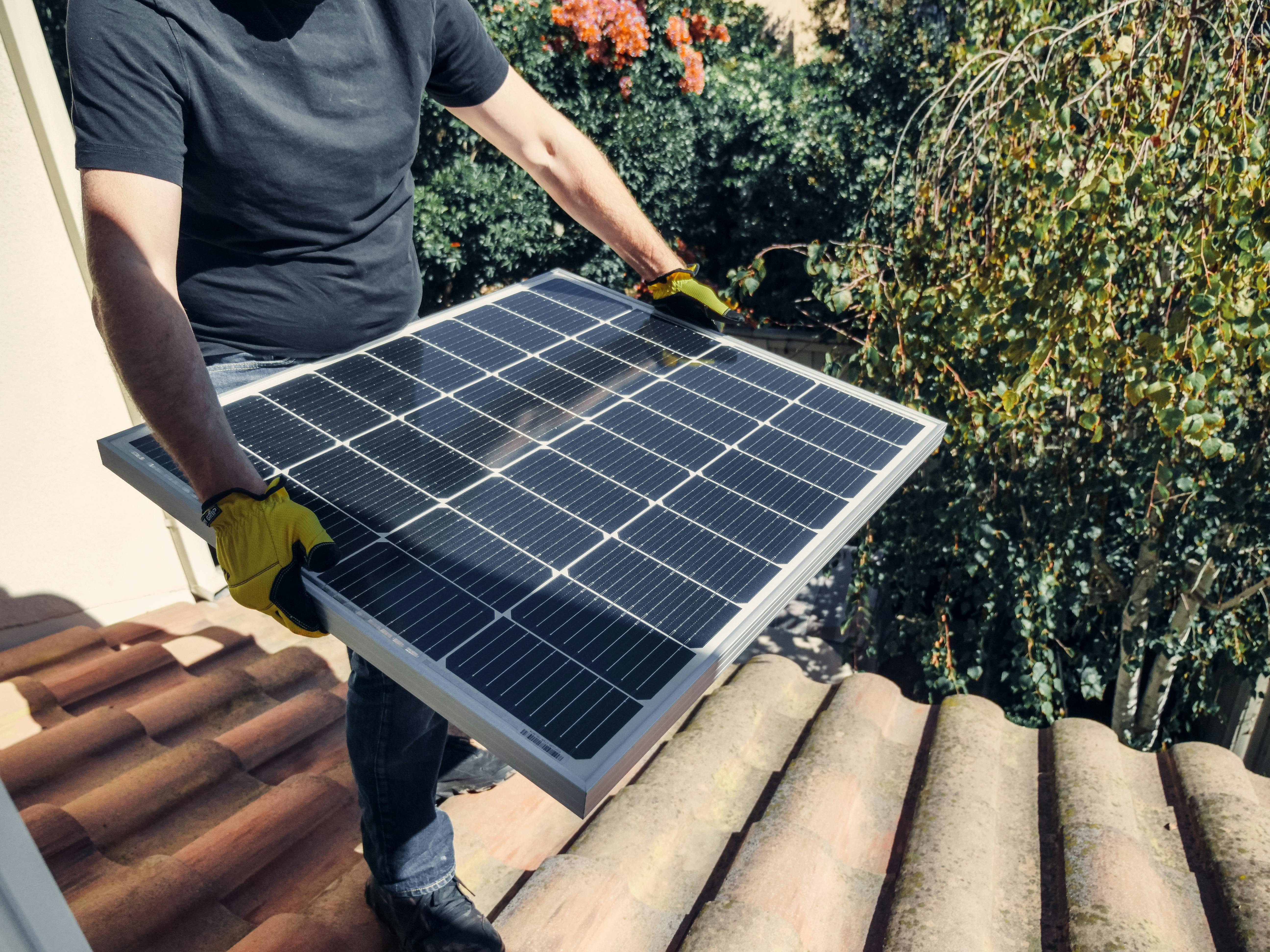
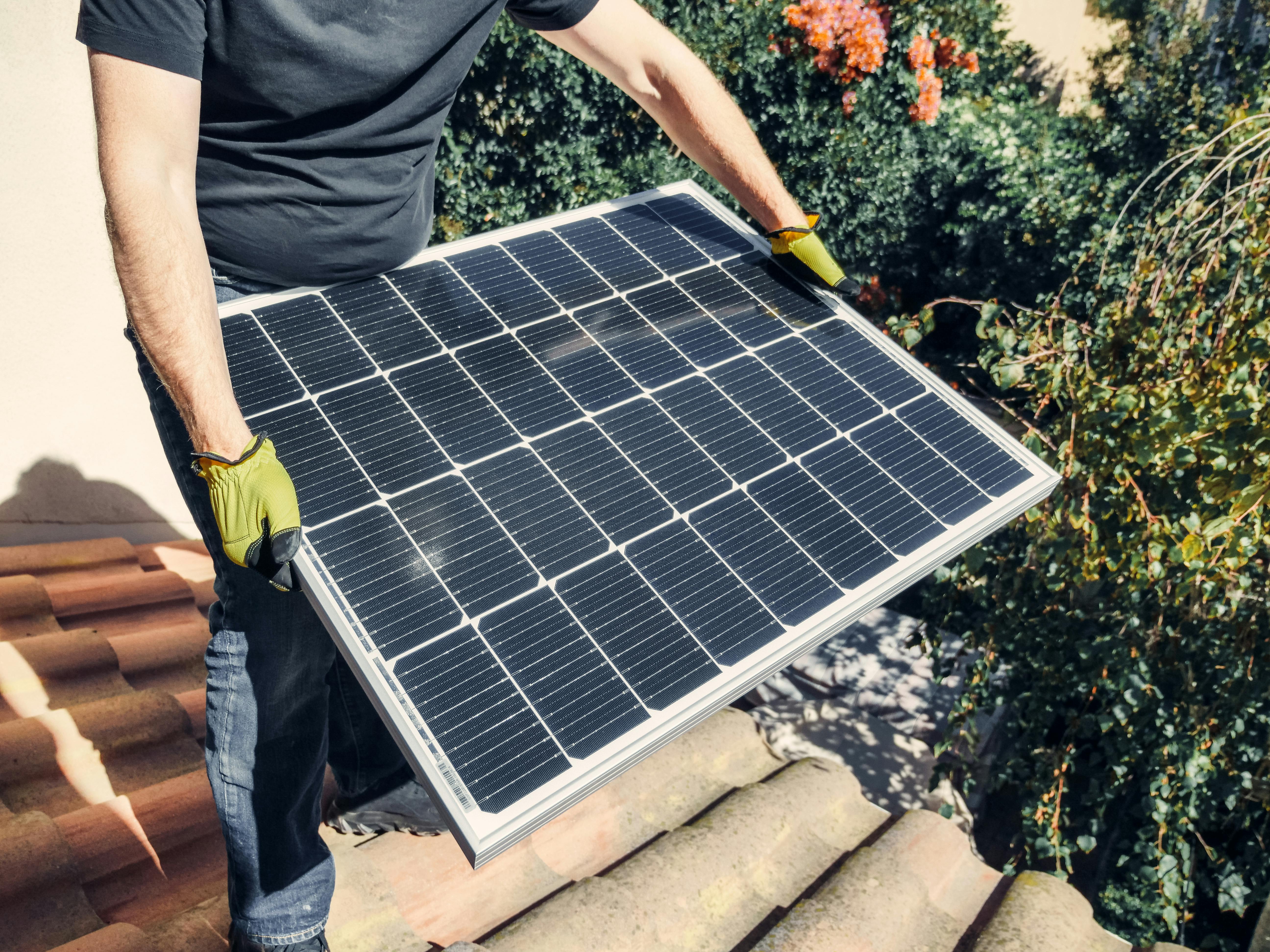
Visualizing Perovskite–Silicon Tandem Technology


Chemistry and Materials Engineering Behind Record Efficiencies
The leap in tandem performance over the last few years is intimately tied to detailed chemistry and interface engineering. Stability, defect passivation, and band alignment are tackled simultaneously through compositional tuning and thin‑film processing.
Stability Engineering
Early metal‑halide perovskites such as methylammonium lead iodide (MAPbI3) degraded readily under moisture, oxygen, elevated temperature, and UV illumination. Modern wide‑bandgap tandem perovskites use mixed cations and halides:
- Cation mixing: incorporation of formamidinium (FA+), cesium (Cs+), and sometimes methylammonium (MA+) to stabilize the crystal structure and suppress phase segregation.
- Halide mixing: controlled I/Br ratios to tune bandgap and resist halide migration under bias and illumination.
- Additives and dopants: small‑molecule or polymer additives to control grain growth, reduce defect density, and improve moisture tolerance.
“Compositional engineering has transformed perovskites from fragile, lab‑only absorbers into materials capable of surviving the thermal and operational stresses demanded by real‑world PV.” — Excerpt adapted from recent Nature Energy reviews
Interface Chemistry and Defect Passivation
Recombination at grain boundaries and interfaces is a major loss pathway in perovskite films. To combat this, researchers focus on:
- Self‑assembled monolayers (SAMs): anchoring molecules that form ordered monolayers to tune energy levels and passivate surface traps at the perovskite/transport‑layer interface.
- Fullerene derivatives (e.g., PCBM): widely used as electron‑selective layers and defect passivators at the perovskite surface.
- Polymeric interlayers: conductive or insulating polymers that smooth roughness, improve wettability, and reduce interfacial recombination.
Advanced characterization techniques such as transient photovoltage, time‑resolved photoluminescence, and Kelvin probe force microscopy help pinpoint where recombination occurs and inform targeted chemical treatments.
Lead, Toxicity, and Encapsulation
Most high‑efficiency tandem perovskites remain lead‑based due to their superior optoelectronic performance. This raises concerns about lead leakage in case of module damage. Mitigation strategies include:
- Advanced encapsulation with multilayer barrier films designed to contain lead and prevent water ingress.
- Lead‑absorbing layers or resins within the module stack that can immobilize Pb2+ ions if the perovskite decomposes.
- Research into lead‑reduced or lead‑free alternatives (e.g., Sn‑based perovskites), though these currently lag behind in efficiency and stability.
Policy and sustainability discussions often center on life‑cycle analysis, recycling pathways, and regulations to ensure perovskite deployment does not compromise environmental or public health goals.
Scientific Significance and Impact on Solar Physics
Perovskite–silicon tandems are not just an engineering upgrade; they are a testbed for fundamental questions in semiconductor physics, defect chemistry, and light‑matter interaction. By combining a traditional inorganic semiconductor with an emerging soft, ionic semiconductor, tandems push the boundaries of device physics.
Exceeding the Single‑Junction Shockley–Queisser Limit
Single‑junction cells have an inherent trade‑off between absorption of high‑energy photons and thermalization losses. Tandems partially circumvent this:
- High‑energy photons are absorbed in the wide‑bandgap perovskite, generating higher voltage.
- Lower‑energy photons pass through to the silicon cell, reducing thermalization losses.
- The result is a higher open‑circuit voltage and improved overall PCE.
Hybrid Electronic–Ionic Behavior
Metal‑halide perovskites exhibit mixed electronic and ionic conduction, especially under bias and illumination. Ion migration can both aid and hinder performance. Understanding these processes informs:
- Strategies to minimize hysteresis in JV curves.
- Approaches to stabilize band alignment over time.
- Design rules for defect‑tolerant, long‑lived devices.
“Perovskites have forced us to rethink what a good semiconductor looks like—tolerance to defects and dynamic ionic behavior can coexist with outstanding optoelectronic performance.” — Paraphrased from leading perovskite researchers in Joule
Insights gained from tandem research also spill over into light‑emitting diodes, photodetectors, and radiation detectors based on perovskite materials.
Milestones: Breaking Efficiency Records
Since around 2015, certified perovskite–silicon tandem efficiencies have climbed at an unprecedented pace compared with earlier PV technologies. While exact numbers continue to evolve, key milestones include:
- Early proof‑of‑concept tandems exceeding 20% efficiency using simple MAPbI3 layers.
- Mid‑2010s: efficiencies around 23–25% with improved interlayers and mixed‑cation perovskites.
- Late 2010s to early 2020s: surpassing 29–30% with careful bandgap tuning and interface passivation.
- Recent reports (mid‑2020s): multiple groups reporting certified efficiencies above 32–33% for small‑area cells.
Importantly, recent progress has focused not only on peak PCE but also on:
- Stability under accelerated aging: proving 1,000–4,000+ hours of operation under damp heat and light‑soaking tests.
- Scaling from lab cells to mini‑modules: demonstrating uniformity and yield over larger areas.
- Process compatibility: aligning perovskite deposition with high‑throughput silicon production lines.
These results frequently appear in high‑impact journals such as Nature Energy, Science, Joule, and Advanced Energy Materials, and are amplified by news outlets and social platforms, feeding public and investor enthusiasm.
Applications, Market Outlook, and Tech Ecosystem
Perovskite–silicon tandems promise higher power density and potentially lower levelized cost of electricity (LCOE), with implications across residential, commercial, and utility‑scale solar.
Where Tandems Can Make the Biggest Impact
- Space‑constrained rooftops: more watts per square meter translate directly into higher energy yield where area is limited.
- Utility‑scale plants: incremental PCE gains can significantly improve project economics and reduce land use.
- Building‑integrated photovoltaics (BIPV): tunable perovskites could offer colored or semi‑transparent top cells for architectural applications.
Integration With Storage and Smart Grids
Higher‑efficiency tandems pair naturally with storage solutions and smart inverters to maximize grid value. For home systems integrating batteries, tools like high‑efficiency panels and lithium‑ion storage can work together to reduce reliance on the grid.
For readers interested in hands‑on solar and storage concepts, consumer‑grade solutions such as the Jackery Explorer 500 Portable Power Station demonstrate how compact solar‑charging systems integrate photovoltaics, batteries, and inverters into a single package.
On the measurement side, professionals and advanced hobbyists often use high‑accuracy multimeters and IV‑curve tracers—for example, a benchtop instrument in the same class as the Fluke 87V Industrial Multimeter —to characterize solar devices, though dedicated PV analyzers are typically used in research labs.
As tandems move toward commercialization, analysts expect them initially to target premium segments where higher efficiency commands a price premium, then gradually spread as manufacturing costs decline and reliability data accumulate.
Challenges on the Road to Commercialization
Despite impressive laboratory progress, several hurdles remain before perovskite–silicon tandem modules can be deployed at terawatt scale.
Long‑Term Stability and Reliability
The most prominent challenge is ensuring multi‑decade stability under real‑world conditions:
- Maintaining performance under high humidity, temperature cycling, and UV exposure.
- Preventing phase segregation and ion migration over extended operation.
- Ensuring that encapsulation and barrier layers remain intact throughout the module lifespan.
Scale‑Up and Manufacturing Yield
Scaling from small (sub‑cm2) cells to full‑size modules introduces new issues:
- Uniform coating of perovskite layers over large areas without pinholes or thickness variations.
- Reproducible formation of high‑quality interfaces at industrial throughput.
- Maintaining yield and minimizing defects that could compromise module reliability.
Supply Chain, Sustainability, and Regulation
Commercialization also depends on:
- Availability and cost of critical raw materials (e.g., indium for TCOs, lead management strategies).
- Compliance with emerging regulations on hazardous substances and recycling.
- Transparent life‑cycle assessments comparing tandems with incumbent silicon modules.
“To unlock the full potential of advanced PV technologies, we must address not only efficiency but also durability, sustainability, and circularity across the value chain.” — Adapted from International Energy Agency (IEA) technology outlooks
Media Buzz, Search Trends, and Public Perception
Every new record efficiency, major funding round, or pilot‑line announcement for perovskite–silicon tandems tends to ignite a flurry of coverage in science news outlets, clean‑tech blogs, and mainstream media. This is quickly reflected in search trends on platforms such as Google, where queries like “perovskite solar cell,” “tandem PV,” and “perovskite stability” periodically spike.
YouTube creators and science communicators play a crucial role in explaining complex concepts—bandgaps, interfaces, and stability engineering—to broader audiences. Professional networks like LinkedIn see active discussion among PV engineers, chemists, and project developers who share white papers, preprints, and conference talks.
For an accessible visual introduction, readers can explore explainer videos such as:
- YouTube search: Perovskite–Silicon Tandem Solar Cells
- LinkedIn professional discussions on tandem PV
Influential scientists and institutes—such as NREL, Helmholtz‑Zentrum Berlin, EPFL, and Oxford PV—regularly post updates on institutional websites and social media, which help set expectations and counteract hype with transparent data on stability and scale‑up.
Conclusion: From Record Cells to Real‑World Power Plants
Perovskite–silicon tandem solar cells sit at the intersection of chemistry, materials science, and large‑scale energy engineering. They have already demonstrated that it is possible to push beyond the practical efficiency limits of silicon alone using tunable, solution‑processable perovskite absorbers carefully integrated on top of mature silicon technology.
The key questions for the coming years are not whether tandems can achieve high efficiency—they clearly can—but whether they can deliver:
- Decades‑long stability under field conditions.
- High manufacturing yield at competitive costs.
- Environmentally responsible deployment with robust recycling and lead management.
If these challenges are met, perovskite–silicon tandems could play a central role in accelerating global decarbonization, enabling more solar power from rooftops, deserts, and floating PV farms worldwide—and possibly laying the groundwork for even more advanced multi‑junction architectures in the future.
Practical Next Steps for Interested Readers
To dive deeper into this rapidly evolving field, consider the following actions:
- Follow leading research groups and labs via institutional pages and preprint servers (e.g., arXiv).
- Read recent review papers in journals like Nature Energy, Joule, and Advanced Energy Materials for comprehensive overviews.
- Track technology roadmaps from organizations such as the International Energy Agency (IEA) and NREL PV program.
- Engage with conference content from events like the IEEE PV Specialists Conference or EU PVSEC, many of which share keynotes and recorded talks online.
Staying informed about both the scientific details and the broader policy and market context will help you critically evaluate new “record” announcements and understand how close tandems truly are to transforming our energy systems.
References / Sources
Selected reputable sources for further reading:
- NREL Best Research-Cell Efficiencies chart (regularly updated): https://www.nrel.gov/pv/cell-efficiency.html
- NREL Perovskite Solar Cells research overview: https://www.nrel.gov/pv/perovskite-solar-cells.html
- International Energy Agency (IEA) Solar PV reports: https://www.iea.org/reports/solar-pv
- Nature Energy – Review articles on perovskite–silicon tandem solar cells: https://www.nature.com/search?q=perovskite+silicon+tandem+solar
- Joule – High‑efficiency perovskite and tandem PV papers: https://www.cell.com/joule/search?keys=perovskite+tandem
- Oxford PV technology overview: https://www.oxfordpv.com/technology
