
Why Spatial Computing Headsets Are the Next Big Interface After Smartphones
Once dismissed as another tech fad after multiple hype cycles, augmented reality (AR), virtual reality (VR), and mixed reality are back at the center of the technology conversation under a new banner: spatial computing. Major platforms—from Apple and Meta to Microsoft, Sony, and emerging XR startups—are investing billions into head‑worn computing, hoping to define what comes after the smartphone. Reviews on outlets like The Verge, TechCrunch, Engadget, TechRadar, and Wired now routinely treat headsets not as curiosities, but as serious, if early, contenders for work, play, and communication.
At the heart of this renewed push are three converging trends: far better hardware (from displays to sensors), more mature software and app ecosystems, and rapid advances in on‑device AI that can make headsets context‑aware and responsive. Yet the core question remains unresolved: are spatial computers destined to become everyday companions like smartphones, or will they remain specialized tools for gaming, design, and professional training?
Mission Overview: Why Spatial Computing Matters Now
The “mission” driving today’s headset race is ambitious: create a general‑purpose computer that understands the geometry, objects, and people around you, and that overlays useful digital information directly into your field of view. Rather than looking down at a phone, you look “through” a headset at a blended digital‑physical world.
“Spatial computing is not just about immersion—it’s about context. The system knows where you are, what you’re looking at, and what you’re doing, and can adapt in real time.”
This mission has ripple effects across:
- Human–computer interaction (post‑smartphone interfaces).
- Enterprise workflows (training, simulation, remote assistance).
- Entertainment and social presence (games, shared virtual spaces).
- Education and design (3D visualization, digital twins, CAD).
Technology: Hardware Advances Powering Spatial Computing
The latest generation of headsets shows clear progress compared with the early Oculus Rift, HTC Vive, or first‑gen HoloLens era. Teardowns and lab tests highlight improvements along several key axes: visual fidelity, comfort, tracking accuracy, and mixed‑reality passthrough quality.

Displays and Optics
Head‑mounted displays are transitioning to high‑resolution OLED and micro‑OLED panels with pixel densities sufficient to display readable text and detailed UI elements.
- Higher resolution and pixel density reduce the “screen‑door” effect and make documents, IDEs, and spreadsheets usable for longer periods.
- Higher refresh rates (typically 90–120 Hz) and low‑persistence displays reduce motion blur and help mitigate motion sickness.
- Improved lenses (pancake optics, better coatings) narrow optical distortions and allow slimmer designs.
Passthrough and Mixed Reality
Mixed reality depends heavily on passthrough cameras and low‑latency compositing of the real and virtual worlds.
- Color passthrough replaces the grainy monochrome views of older devices.
- Depth sensing and SLAM (simultaneous localization and mapping) allow the headset to understand room geometry in real time.
- Occlusion and lighting integration make virtual objects appear more physically present in your space.
Tracking: Eyes, Hands, Controllers
Inside‑out tracking, which uses onboard cameras and inertial measurement units (IMUs), has become standard, eliminating the need for external base stations in many devices.
- Eye tracking supports foveated rendering, which renders full resolution only where you’re looking, cutting GPU load.
- Hand and gesture tracking reduce reliance on controllers for basic interactions like pinching, swiping, and typing on virtual keyboards.
- Controller tracking remains crucial for precise input in gaming and design tools (e.g., 3D modeling, CAD).
Dedicated Silicon and Sensor Fusion
Spatial computing headsets now integrate dedicated chips for sensor fusion and AI workloads, often alongside mobile‑class application processors.
- Custom silicon processes camera feeds, IMU data, and depth information to maintain low‑latency tracking.
- Neural processing units (NPUs) accelerate tasks like hand pose estimation, scene understanding, and eye‑gaze prediction.
- Thermal design and power management remain constraints, especially for fully untethered devices.
Despite these gains, battery life (often 2–3 hours of active use) and headset weight are still the main ergonomic pain points mentioned in reviews by Engadget, TechRadar, and others.
Mission Overview: Platform Strategies and Ecosystem Race
Hardware alone does not guarantee success. The real competition lies in who can build the most compelling spatial computing platform—a combination of OS, app store, SDKs, cloud services, and monetization models that attracts both developers and users.
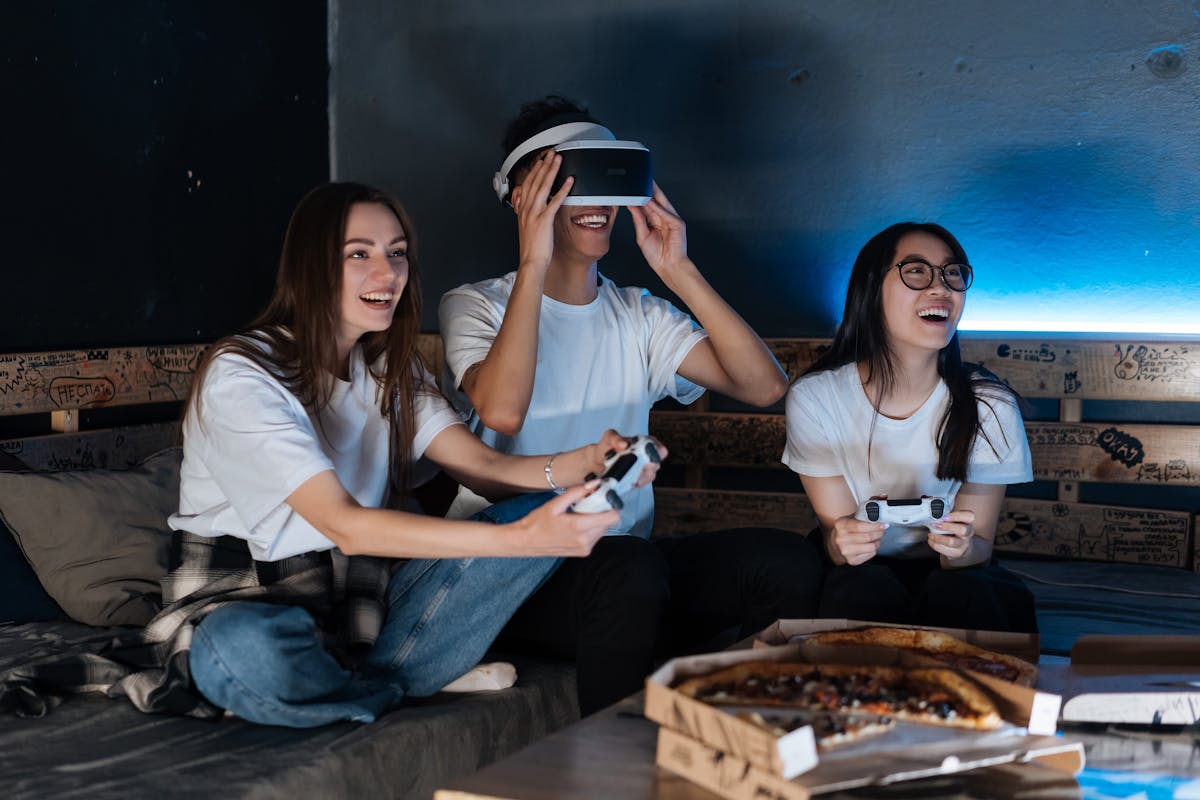
Beyond Gaming: Productivity, Design, and Collaboration
TechCrunch, The Verge, and other outlets have repeatedly highlighted that this generation of headsets is pushing hard beyond games:
- Virtual multi‑monitor setups that let users spread out documents and apps in 3D space.
- 3D design tools for architecture, industrial design, and digital twins.
- Immersive meeting apps where participants appear as avatars or volumetric video in shared virtual spaces.
- Training and simulation for medicine, aviation, manufacturing, and field service.
Developer Incentives and SDKs
To build these experiences, platform owners offer:
- Native XR SDKs integrating rendering, spatial mapping, input, and UI frameworks.
- WebXR and cross‑platform engines (Unity, Unreal, Godot) to reduce friction in targeting multiple devices.
- Revenue‑sharing models and potential subsidies for early flagship apps and games.
“The real battle is not just for headset sales this holiday season—it’s for the developers who will define what ‘everyday’ spatial apps look like.”
Will Spatial Apps Become Daily Habits?
A recurring question in reviews and opinion pieces: can spatial apps turn into habits the way checking email or social feeds on phones did?
- Are virtual screens genuinely better than physical monitors for 8‑hour workdays?
- Will professionals prefer 3D modeling in mid‑air, or still gravitate to mouse and keyboard?
- Can remote meetings in mixed reality feel natural enough to replace some in‑person sessions?
The answers will determine whether headsets become mainstream productivity tools or remain niche devices for gamers and specialized professionals.
Technology: AI, WebXR, and the Spatial Computing Stack
On forums like Hacker News and in developer blogs, much of the debate focuses on the software stack behind spatial computing and how AI will fuse with XR.
Rendering and WebXR
Rendering pipelines for headsets must deliver high frame rates at low latency while accounting for two eyes, lens distortion, and dynamic foveated rendering.
- Native engines (Unity, Unreal) still dominate complex XR apps.
- WebXR offers browser‑based mixed‑reality experiences, lowering distribution friction and enabling cross‑platform access.
- OpenXR as a standard aims to reduce fragmentation across headsets.
On‑Device AI and Context Awareness
Many researchers expect a tight convergence of AI assistants and spatial computing:
- Semantic scene understanding: headsets label objects, surfaces, and people in real time.
- Task‑aware assistance: AI agents can see what document you’re reading or what device you’re repairing and offer step‑by‑step guidance.
- Natural interaction: speech, gaze, and gestures combine into fluid multimodal input.
“Spatial interfaces without intelligence are just fancy screens; intelligence without spatial grounding lacks context. The next decade belongs to their fusion.”
Edge, Cloud, and Latency
While some AI models can run locally, heavier inference (e.g., large vision‑language models) often relies on the cloud or nearby edge servers. This introduces trade‑offs:
- Local processing improves privacy and responsiveness but is limited by power and thermals.
- Cloud offload enables richer models but depends on connectivity and can add latency.
- Hybrid strategies keep critical tracking and safety on‑device while streaming higher‑level intelligence from the edge.
Scientific Significance: Human Perception, Ergonomics, and Behavior
Beyond gadgets, spatial computing is a living experiment in applied neuroscience, ergonomics, and social psychology. Each generation of headsets tests how far we can push immersion without overwhelming human perception and comfort.

Vision and Motion: Cybersickness and Comfort
Researchers study how mismatches between visual input and vestibular cues cause discomfort or “cybersickness.” Improvements in optics, frame rates, and motion prediction mitigate this, but:
- Some users remain highly sensitive to motion artifacts.
- Long‑duration use for productivity is still under active study.
- Best practices (breaks, calibrated IPD, gradual exposure) are crucial, especially for new users.
Social Presence and Behavioral Changes
Social experiences in XR—shared virtual workspaces, games, or events—raise questions:
- Presence: can avatars or volumetric video truly replicate “being there” with colleagues or friends?
- Behavior: how do anonymity, embodiment, and spatial distance affect behavior, empathy, and conflict?
- Norms: what etiquette emerges around wearing headsets in public or shared environments?
“With great immersion comes great responsibility. We are rewriting the rules of attention and presence.”
Milestones: From Early VR to Spatial Computing Platforms
The current wave of spatial computing builds on decades of VR and AR research, plus several commercial false starts. Media timelines often highlight a rough progression:
Key Historical Milestones
- 1960s–1990s: Foundational academic VR/AR prototypes; head‑mounted displays in labs.
- 2012–2016: Consumer VR resurgence with Oculus Rift, HTC Vive, PlayStation VR; early AR experiments like Google Glass.
- 2016–2020: Enterprise‑focused AR with Microsoft HoloLens and Magic Leap targeting industrial and medical use cases.
- 2020–2024: Standalone VR headsets reach mass market; mixed‑reality passthrough becomes mainstream; “spatial computing” enters the vocabulary of big tech and media.
Media and Community Milestones
Coverage in The Verge, TechCrunch, Engadget, TechRadar, and Wired now treats headsets as a recurring beat, not a novelty.
On the community side, developer‑centric sites and forums like Hacker News, the r/virtualreality and r/oculus subreddits, and GitHub repositories tracking WebXR and OpenXR projects have become real‑time barometers of technical progress and sentiment.
Challenges: Privacy, Safety, and Societal Questions
While the engineering advances are impressive, spatial computing raises profound challenges that regulators, researchers, and the public are only beginning to grapple with.
Privacy and Surveillance Concerns
Headsets rely on an array of “always‑on” sensors—RGB cameras, depth sensors, microphones, eye trackers, and sometimes biometric sensors. Wired‑style investigations and privacy advocates ask:
- What exactly is recorded, stored, or transmitted off device?
- How long are spatial maps of your home or office retained, and by whom?
- Are eye‑tracking data or subtle behavioral signals used for targeted advertising?
“If your headset knows what you look at, how long you look, and how you react, that’s the most intimate analytics pipeline we’ve ever built.”
Regulation and Standards
Regulators are starting to apply lessons from smartphones and smart speakers to spatial computing:
- Data protection rules (e.g., GDPR‑style principles) for spatial and biometric data.
- Transparency requirements about what is being captured and why.
- Safety standards for prolonged use, especially for younger users or in work environments.
Ergonomics and Long‑Term Use
Even as devices become lighter, questions persist about:
- Neck strain and posture when wearing headsets for hours.
- Eye strain from close‑up displays and vergence–accommodation conflicts.
- Balancing immersion with situational awareness, particularly in public or industrial spaces.
Milestones in Culture: YouTube, TikTok, and Everyday Perception
The cultural life of spatial computing is unfolding on YouTube, TikTok, and livestream platforms, where creators share unboxings, app reviews, mixed‑reality captures, and candid diaries of “living in VR for a week.”
Influencer Demos and Public Expectations
These videos shape mainstream expectations by highlighting:
- Magical first impressions: room‑scale games, creative apps, immersive travel experiences.
- Current limitations: headset weight, battery life, imperfect hand tracking, limited killer apps.
- Unexpected use cases: virtual study spaces, focused work sessions, fitness and meditation apps.
Many creators also discuss practical aspects—fogging lenses, comfort mods, and best accessories—helping new users navigate early friction.
Practical Tools: Accessories and Developer Gear
For professionals and enthusiasts investing in spatial computing, the right hardware ecosystem can significantly improve comfort and productivity.
Comfort and Productivity Accessories
Depending on your headset, you may benefit from:
- Counter‑balance straps to reduce front‑heavy pressure on the face.
- Prescription lens inserts for users who wear glasses.
- High‑quality over‑ear or in‑ear audio for extended work sessions.
Many users also pair their headsets with ergonomic keyboards and mice optimized for long hours, such as the Logitech MX Keys Advanced Wireless Keyboard, which offers low‑profile keys and multi‑device pairing—useful if you frequently switch between a laptop, desktop, and XR‑enabled machine.
Developer‑Focused Setups
Developers building XR apps often invest in:
- High‑performance GPUs for rapid iteration in Unity or Unreal.
- USB‑C hubs and reliable Wi‑Fi 6/6E routers for low‑latency wireless streaming during testing.
- Comfort tweaks (face gaskets, counterweights) for multi‑hour debugging sessions inside headsets.
Conclusion: The Long Road Beyond the Smartphone
Spatial computing headsets have clearly moved beyond their novelty phase. We now have:
- Substantially improved hardware with high‑resolution displays and mixed‑reality passthrough.
- Major platform owners competing to build app ecosystems and developer communities.
- Growing convergence with AI that promises context‑aware assistance woven into our environments.
At the same time, big unanswered questions remain about privacy, ergonomics, and whether truly indispensable everyday use cases will emerge. The outcome is unlikely to be a simple “VR replaces phones”; more plausibly, we may see a spectrum of devices, from lightweight AR glasses for glanceable information to full‑featured spatial computers for creative work, simulation, and collaboration.
For now, spatial computing is best understood as an active frontier: a space where hardware engineering, software platforms, human‑factors research, and policy all collide. The race for headsets is not just about who sells the most devices—it is about who defines the next grammar of computing in three dimensions.
Additional Resources and Further Reading
To dive deeper into the technical, social, and business dimensions of spatial computing, consider the following types of resources:
- Technical standards and specs: Khronos OpenXR, Immersive Web / WebXR documentation.
- Human‑factors and ergonomics research: IEEE VR conference proceedings, ACM CHI papers on VR/AR interaction and cybersickness.
- Developer guides and talks: Official Unity and Unreal XR documentation, GDC and SIGGRAPH talks on rendering, input, and UX in XR.
- Policy and ethics perspectives: Reports from Electronic Frontier Foundation (EFF) on AR/VR privacy and analyses from digital rights organizations.
For a visual overview of current headsets, their capabilities, and practical use cases, curated YouTube playlists from reputable tech reviewers (such as channels commonly featured on The Verge, Engadget, or independent XR specialists) are especially useful to see where the technology shines—and where it still falls short—in real‑world scenarios.
References / Sources
Selected sources covering spatial computing, AR/VR hardware, and platform strategies:
