
Stranger Things Season 5, Volume 2 Review: Netflix’s Crown Jewel Races Toward the Upside Down Endgame
As Stranger Things barrels toward its series finale with the second volume of season 5, it feels less like a farewell tour and more like a victory lap through its own mythology. Netflix’s flagship genre show isn’t just wrapping a story about kids versus cosmic horror; it’s closing the book on an entire era of streaming TV that it helped define.
Volume 2 of the fifth season drops amid a uniquely staggered release schedule—Thanksgiving, Christmas, and the New Year—turning Hawkins’ last stand into a holiday event trilogy. The result, as RogerEbert.com notes in its coverage, is a penultimate chapter that’s almost nostalgic for itself: a season that remembers what made the show a phenomenon while trying to evolve beyond its own greatest hits.
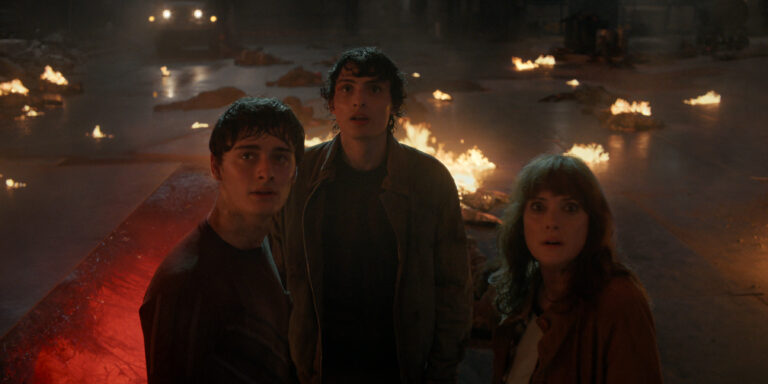
A Holiday Event Strategy: How Netflix Is Saying Goodbye
Netflix’s decision to split the final season into three volumes—landing on Thanksgiving, Christmas, and New Year—is more than a programming quirk. It’s a tacit acknowledgment that Stranger Things is one of the last true “event” shows of the streaming era, the kind of series that can still claim cultural holidays of its own.
Where earlier seasons dropped all at once for instant binges, season 5’s staggered rollout invites a more old-school, communal experience. Volume 2 functions as the emotional and narrative hinge: most of the big chess pieces are finally on the same board, but the checkmate is still a release away.
“We always knew the ending would have to feel both massive and intimate, like the end of a summer with your friends and the end of the world at the same time.”
— The Duffer Brothers, on shaping the final season
It also reflects a broader industry trend: streamers are increasingly stretching out their heavy hitters—think The Crown or Ozark—to sustain buzz, subscriber engagement, and awards consideration. Stranger Things, the show that once defined the binge model, is now being used to test the hybrid “mini-event” format.
Nostalgic for Itself: When a Cult Hit Becomes Its Own Reference
The phrase circulating in early coverage—that the penultimate volume feels “nostalgic for itself”—isn’t an insult so much as a diagnosis. By season 5, Stranger Things is no longer just riffing on Spielberg, Carpenter, and King; it’s riffing on Stranger Things.
- Echoed visuals of kids biking into danger, now with grown-up stakes.
- Callbacks to earlier monster designs, remixed through the Vecna arc.
- Emotional beats—found family, sacrificial heroism, misfit solidarity—replayed with heavier baggage.
This kind of self-mirroring is inevitable for long-running genre franchises, but it’s a tricky balance. When it works, it feels mythic, like the show is completing a narrative circle. When it doesn’t, it risks playing like fan service or, worse, a greatest-hits compilation.
Volume 2 leans into that tension. It revisits core dynamics—Eleven versus institutional power, Hopper as grizzled protector, the Party fractured but spiritually united—while escalating the cosmic horror. The result can feel like a remix album: familiar hooks, new production.
Character Arcs Under Pressure: Growing Up in the Upside Down
One of the more interesting tensions in late-stage Stranger Things is that it started as a show about kids and is ending as a story about traumatized young adults. Volume 2 carries that weight—these aren’t the wide-eyed D&D nerds of season 1; they’re veterans of repeated apocalypses.
- Eleven: Still the psychic nucleus, but more conflicted about what her power means, especially as the show foregrounds the toll of being weaponized from childhood.
- Hopper & Joyce: Their arc leans into blue-collar heroism and queer-adjacent outsider solidarity, grounding the more bombastic set pieces.
- Mike, Will, and the Party: Volume 2 continues paying off Will’s long-simmering emotional storyline and the complicated nostalgia of “the party” growing apart.
“We were always interested in what happens after the adventure. What if E.T. doesn’t go home? What if the kids have to live with this forever?”
— A Duffer Brothers comment in past interviews, echoed in the mood of the final season
Critics, including those at RogerEbert.com, have pointed out that this character work is where the show still finds surprising textures. Even when the plot machinery creaks under the strain of so many subplots, an offhand glance between long-time friends can land harder than an entire CGI set piece.

Spectacle vs. Horror: Has Stranger Things Become Too Big?
By the time we reach Volume 2 of season 5, Stranger Things is operating at blockbuster scale: multi-location battle lines, massive digital environments, and a visual language closer to tentpole cinema than mid-budget TV. The question is whether the show’s horror roots survive that escalation.
The later seasons’ villain, Vecna, steers the series toward a more overtly gothic, psychologically inflected evil, and Volume 2 continues to fold classic horror tropes—body horror, dreamscapes, possession—into widescreen spectacle. The Upside Down now feels like a fully realized mythos rather than a shadowy rumor.
Some critics argue that this bigness undercuts the primal fear that animated season 1, where a single missing kid and a few flickering lights were scarier than any tentacled CGI behemoth. Others see the expansion as logical: if you keep opening portals to hell, eventually you’re going to get an apocalypse.
Cultural Impact: From 80s Remix to Streaming Landmark
Beyond the specifics of Volume 2, it’s impossible to talk about Stranger Things in 2025 without acknowledging its cultural footprint. This is the show that:
- Resurrected Kate Bush’s “Running Up That Hill” into a global chart hit decades after release.
- Helped normalize cross-generational genre fandom, with parents and teens watching together.
- Became Netflix’s de facto brand identity: emotional, nostalgic, vaguely spooky, endlessly bingeable.
Volume 2 leans into that legacy without completely coasting on it. The storytelling still wants to mean something about friendship, found family, and the ways ordinary people navigate extraordinary horror. Even when the series indulges in its own iconography, it rarely feels cynical.

For Netflix, the show’s farewell is both an ending and a test: can the platform cultivate another four-quadrant phenomenon with this level of cultural penetration? For audiences, it’s a chance to say goodbye to characters who’ve essentially grown up in parallel with a generation of viewers.
Strengths and Weaknesses of Season 5, Volume 2
Judging by early critical conversation, including the tone of the RogerEbert.com coverage, Volume 2 lands somewhere between triumphant and overstuffed.
- Strengths:
- Strong emotional payoffs for long-running character arcs.
- Confident direction and production design that make Hawkins and the Upside Down feel tactile.
- A sense of thematic continuity: trauma, friendship, and the cost of heroism stay front and center.
- Weaknesses:
- Occasional pacing bloat as the show juggles a sprawling ensemble.
- Some subplots feel more like obligations to fan-favorite characters than organic storytelling.
- The sheer scale of the apocalypse can blur individual stakes at times.

If Volume 1 of the season did the heavy lifting of assembling the board and Volume 3 will deliver the checkmate, Volume 2 is the tense middle game: not always elegant, but often gripping, and clearly driven by affection for this world and these characters.
Watch the Trailer and Explore More
For a taste of the tone and scale of the final run, the official Netflix trailer for Stranger Things Season 5 highlights the collision of personal stakes and apocalyptic horror that defines Volume 2.
You can follow official updates and credits on:
- Stranger Things on Netflix
- Stranger Things on IMDb
- RogerEbert.com TV/Streaming section for full reviews and essays
Final Thoughts: The End of Hawkins, the End of an Era
As Stranger Things heads into its final volume, Season 5’s second chapter feels like a deep breath before the plunge. It’s self-aware, occasionally indulgent, and frequently moving—a show looking back at its own reflection while still trying to push forward.
Whether the finale sticks the landing will determine how we ultimately rank Stranger Things in the pantheon of TV greats. But Volume 2 makes one thing clear: however messy the road has been, few series have captured the blend of genre spectacle, genuine feeling, and pop-cultural electricity that this one has sustained for nearly a decade.
One way or another, when the last credits roll, the Upside Down will close not just on Hawkins, but on a chapter of how we watch television itself.
