
Why Comet 3I ATLAS Is Baffling Astronomers With a 600,000-Mile Sunward Tail
Introduction: A comet that breaks the rules
Comet 3I ATLAS has rapidly become one of the most intriguing objects in the Solar System. Currently around 186 million miles from Earth—roughly twice the Earth–Sun distance—it is moving away from the Sun yet paradoxically growing closer to Earth and displaying a jaw‑dropping, sunward‑pointing tail that may extend nearly 600,000 miles (about 1 million km). That geometry appears to defy the classic textbook picture in which comet tails always stream away from the Sun.
Astronomers and space physicists are now racing to explain 3I ATLAS’s unusual morphology using a combination of high‑resolution imagery, spectroscopy, and advanced plasma models. Its designation “3I” also suggests it may be only the third recognized interstellar comet after 1I/ʻOumuamua and 2I/Borisov, raising the stakes for every observation.
“Every time we think we understand comets, one of them shows up and rewrites the rules. 3I ATLAS may be the next rule‑breaker.”
— Adapted from comments by mission scientists working with NASA heliophysics data
Mission Overview: Tracking Comet 3I ATLAS Through the Inner Solar System
Comet 3I ATLAS (commonly shortened to 3I ATLAS) is being tracked by a loose “virtual mission” involving professional observatories, planetary‑defense networks, heliophysics spacecraft, and a global community of advanced amateurs. Although there is no single dedicated spacecraft mission like ESA’s Rosetta, the combined observational effort rivals a coordinated campaign.
As of late November 2025, key orbital and observational facts include:
- Distance from Earth: ~186 million miles (≈ 2 AU), decreasing until a closest approach around 19 December 2025.
- Direction of travel: Moving away from the Sun on a hyperbolic or near‑hyperbolic trajectory while approaching Earth in a geometric sense.
- Brightness: Currently accessible to medium‑sized backyard telescopes under dark skies, with ongoing brightness variations driven by volatile outgassing.
- Tail structure: Multiple distinct components, including a conventional antisolar tail and an astonishing extended feature pointing roughly toward the Sun.
Observations combine:
- Ground‑based telescopes in visible and near‑infrared bands.
- Space‑based solar observatories (e.g., the Solar Dynamics Observatory and instruments on SOHO) for context on the solar wind and magnetic field.
- Planetary‑defense survey telescopes that refine the orbit and search for activity changes.
The NextBigFuture coverage that drew attention to the “impossible” 600,000‑mile tail has catalyzed further modeling and independent confirmation attempts by both professionals and highly skilled amateurs.
Visual Evidence: What Do We Actually See?
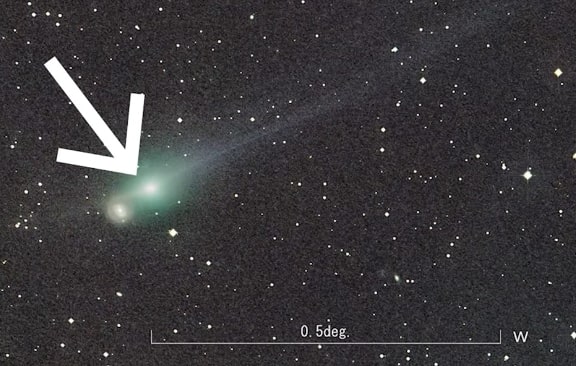
The controversial tail length and orientation come from stacked, contrast‑enhanced images that reveal ultra‑faint structures far beyond the bright coma. In raw frames, 3I ATLAS looks like a condensed core with a modest tail. But when astronomers:
- Align and stack dozens or hundreds of exposures,
- Carefully subtract background stars and galaxies, and
- Stretch the image contrast to bring out low‑surface‑brightness features,
a much longer, filamentary structure emerges. Measured on the sky, this feature translates into a projected length of up to ~600,000 miles at the comet’s current distance.
Importantly, “sunward” here refers to the apparent direction on the sky relative to the Sun’s position, not a literal stream of material shooting directly at the Sun under pure gravity. That nuance is central to understanding the anomaly.
Technology: How We Study an Anomalous Comet Tail
Understanding 3I ATLAS requires a combination of imaging technology, spectroscopy, and plasma modeling tools that have matured significantly since classic comets like Hale‑Bopp or even 67P/Churyumov‑Gerasimenko (Rosetta’s target).
High‑Sensitivity Imaging and Photometry
Advanced CCD and CMOS sensors with high quantum efficiency and low read noise enable astronomers to detect extremely faint structures. Techniques include:
- Long‑exposure stacking: Dozens of exposures are tracked on the comet’s apparent motion to avoid smearing.
- Flat‑fielding and dark subtraction: Calibration frames suppress sensor artifacts and gradients.
- Point‑spread function (PSF) subtraction: Used to remove starlike contaminants that could mimic or hide faint tails.
Many high‑quality amateur observatories employ equipment similar to professional setups. For example, a cooled monochrome camera on a precision equatorial mount paired with a fast astrograph (say an 8‑inch f/4 reflector) can reach the faint surface brightness levels where 3I ATLAS’s extended tail becomes visible.
Spectroscopy and Composition
Low‑ and medium‑resolution spectrographs mounted on 1–4‑meter class telescopes help identify:
- Molecular emission bands (CN, C2, C3),
- Atomic lines (Na, Fe, Ca), and
- Dust continuum reflectance slopes.
These reveal which volatiles are driving the outgassing and how the dust population compares to “typical” Solar System comets. If 3I ATLAS is genuinely interstellar, subtle abundance ratios may differ from local comets, as was observed for 2I/Borisov.
Plasma Modeling, Solar Wind, and Magnetic Fields
The apparently sunward tail suggests strong interaction with the solar wind and the interplanetary magnetic field (IMF). Researchers use magnetohydrodynamic (MHD) simulations to model:
- Neutral gas outflow from the comet nucleus,
- Ionization by solar UV radiation, and
- Pickup of those ions by the solar wind, which carries them along IMF lines.
Under certain geometries, the ion tail can appear offset—or even roughly “sunward”—when projected onto the sky, despite still following the physics of charged particles guided by magnetic fields.
“The surprising morphology of 3I ATLAS is likely a projection effect of an ion tail tracing twisted magnetic field lines in a non‑uniform solar wind.”
— Interpretation consistent with recent AGU heliophysics modeling papers
Tools for Advanced Amateurs and Students
For readers interested in doing their own observations or analyses, a few accessible tools and instruments stand out:
- Celestron LCM computerized reflector telescope – An entry‑level GoTo telescope frequently recommended for beginners who want to track moving objects like comets.
- The open‑source software Astropy and Siril for image calibration and stacking.
- Visualization tools from NASA’s OMNIWeb to inspect real‑time solar wind conditions.
Scientific Significance: Why 3I ATLAS Matters
3I ATLAS sits at the intersection of planetary science, heliophysics, and interstellar medium studies. Its anomalies provide a rare opportunity to test models far from equilibrium.
Window into Interstellar Material
If the “3I” classification holds, this comet is composed of material that condensed around another star or in a very different region of a star‑forming nebula. By measuring:
- Isotopic ratios (e.g., D/H in water vapor),
- Dust albedo and spectral slope, and
- Relative abundances of CO, CO2, and H2O,
scientists can infer conditions in its natal environment. Comparing these with Rosetta’s 67P results and with 2I/Borisov’s peculiar composition helps refine models of planet formation across the Galaxy.
Natural Laboratory for Plasma Physics
Comet–solar‑wind interactions create miniature magnetospheres and bow shocks. The extreme tail geometry of 3I ATLAS is a live test case for:
- How pickup ions are accelerated and deflected,
- How Kelvin–Helmholtz and Rayleigh–Taylor instabilities sculpt comet tails, and
- How transient events like coronal mass ejections (CMEs) reshape a comet’s plasma environment.
Observations from heliophysics missions, combined with comet imagery, make 3I ATLAS a rare multi‑scale experiment that cannot be reproduced in terrestrial laboratories.
Planetary Defense and Survey Capabilities
While 3I ATLAS poses no known impact risk, its detection and characterization benchmark the sensitivity of current sky surveys. Rapid recognition of its odd behavior confirms:
- Survey pipelines can flag unusual activity,
- Follow‑up networks can coordinate globally within days, and
- Data‑sharing platforms (e.g., the Minor Planet Center) remain central to real‑time science.
These same infrastructures underpin planetary‑defense efforts for potentially hazardous objects.
Milestones: Timeline of Key Events and Discoveries
Although detailed ephemerides and discovery logs are still being refined, the broad sequence of 3I ATLAS milestones looks like this:
- Initial detection and orbit fitting – Early survey data establish that the object follows a strongly hyperbolic path, triggering interest as a potential interstellar comet.
- Recognition of unusual tail morphology – Deeper imaging reveals a complex tail system with a long, faint structure apparently oriented toward the Sun.
- Coordinated global observing campaign – Professional observatories and skilled amateurs launch multi‑band monitoring campaigns, sharing processed images, light curves, and spectra.
- Heliophysics modeling efforts – Groups specializing in solar wind and IMF modeling attempt to reproduce the observed geometry via MHD and test‑particle simulations.
- Closest Earth approach (projected around 19 December 2025) – The comet’s reduced distance enhances apparent brightness and tail detectability, enabling the most detailed imagery.
- Post‑encounter analysis – After the comet recedes, astronomers will synthesize imaging, spectral, and plasma data into a coherent physical model of its behavior.
Each milestone also refines the orbital solution, clarifies whether 3I ATLAS is definitively interstellar, and improves our understanding of comet–Sun interactions.
The “Impossible” 600,000‑Mile Tail: What Might Be Going On?
A sunward, 600,000‑mile tail sounds like a violation of basic comet physics. In reality, several mechanisms—especially projection effects and plasma dynamics—can produce such a visual impression without breaking physical laws.
1. Projection and Viewing Geometry
The tail we measure on images is a two‑dimensional projection of a three‑dimensional structure. If:
- The comet’s orbital plane is inclined relative to Earth, and
- The ion tail follows a curved magnetic field line in space,
then the integrated line of sight can align with the Sun’s apparent direction even if the real flow is still largely anti‑solar. This effect can also exaggerate apparent length.
2. Ion Tails vs. Dust Tails
Comets often host multiple tails:
- Dust tail: Dominated by larger grains pushed gently away from the Sun by radiation pressure; usually broad and curved.
- Ion (plasma) tail: Made of ionized gas entrained in the solar wind; narrower, straighter, and more sensitive to the IMF.
The disputed 600,000‑mile feature is almost certainly an ion/plasma structure. Ion tails can:
- Detach during magnetic reconnection events,
- Show kinks and folds following changes in solar wind direction, and
- Appear offset or even quasi‑sunward in projections.
3. Interaction with Solar Wind Discontinuities
When a comet crosses a solar wind sector boundary or an interaction region between fast and slow wind streams, the local IMF can twist sharply. Models of similar events (for instance, at Comet Encke and Comet 2P/Encke encounters with CMEs) show:
- Rapid rotation of the ion tail on timescales of hours,
- Temporary disconnection events, and
- Formation of large‑scale, loop‑like ion structures.
3I ATLAS’s extended “sunward” feature may be one of these detached or highly sheared ion structures captured at just the right (or wrong) time and angle.
4. Systematic Uncertainties in Tail Length Estimates
Tail length estimates depend on:
- Accurate distance measurements to the comet,
- Thresholds used in image contrast stretching, and
- Background subtraction and noise modeling.
It is entirely possible that the quoted 600,000‑mile length is an upper bound that includes extremely low‑surface‑brightness structures close to the noise floor. As more independent reductions appear, a consensus physical length will emerge.
Challenges: Observational, Theoretical, and Communication Hurdles
Studying a rapidly evolving, anomalous comet is not straightforward. Researchers face multiple layers of difficulty.
Observational Challenges
- Low surface brightness: The farthest reaches of the tail are near the detection limit, making them sensitive to processing choices.
- Rapid temporal evolution: Tail structures can change noticeably in a single night, complicating direct comparisons between datasets.
- Weather and scheduling constraints: Even large observatories have limited time windows and must balance 3I ATLAS against other science targets.
Theoretical and Modeling Challenges
Accurate plasma simulations must couple:
- Three‑dimensional gas outflow from an irregular, rotating nucleus,
- Variable ionization rates, and
- Non‑steady‑state solar wind and IMF conditions.
These multi‑physics, multi‑scale problems push the limits of current MHD codes and require high‑performance computing resources as well as well‑constrained boundary conditions from observation.
Public Communication and Misinterpretation
Striking images and phrases like “impossible tail” are powerful for outreach but can unintentionally feed misinformation—especially when amplified on social media without context.
“Extraordinary images deserve extraordinary explanations, not just extraordinary headlines.”
— Paraphrasing commentary from astronomers active on LinkedIn and X (Twitter)
Scientists must strike a balance between honest excitement about anomalies and clear explanations of uncertainties and alternative hypotheses.
How to Observe Comet 3I ATLAS Safely and Effectively
For skywatchers and students, 3I ATLAS is an opportunity to practice responsible, data‑driven observing.
Planning Your Observing Session
- Use ephemeris tools like TheSkyLive or the JPL Horizons system to compute the comet’s current position.
- Check Moon phase, light pollution maps, and weather forecasts; faint tails are easily washed out by bright skies.
- Begin with low magnification to locate the comet, then switch to higher power or imaging once it is centered.
Imaging Tips
- Track at the comet’s rate rather than sidereal rate to avoid smearing the coma.
- Capture many shorter exposures (e.g., 30–120 seconds) instead of a few long frames.
- Use calibration frames (darks, flats, bias) to clean the data.
- Stack and process images with software that preserves linearity for photometry before artistic stretching for aesthetics.
Eye Safety and Solar Proximity
Although 3I ATLAS is nowhere near the Sun’s disk from Earth’s viewpoint right now, general caution is always warranted: never use optical instruments near the Sun without certified solar filters. Comet observing is typically done in dark skies well away from solar glare.
Context: 3I ATLAS Among Other Interstellar Visitors
3I ATLAS follows in the footsteps of two headline‑making visitors:
- 1I/ʻOumuamua (2017): A highly elongated, non‑cometary object with puzzling non‑gravitational acceleration. See the in‑depth review in Nature Astronomy.
- 2I/Borisov (2019): A bona fide interstellar comet with a classic coma and tail but unusual volatile composition, observed by major facilities like Hubble and ALMA.
Compared to these objects, 3I ATLAS:
- Shows more pronounced tail anomalies than 2I/Borisov.
- Offers a better opportunity for extended monitoring than 1I/ʻOumuamua, which was discovered only after perihelion and faded fast.
- Arrives in an era of more capable all‑sky surveys and heliophysics missions, ensuring richer datasets.

Together, these three interstellar objects are forcing a re‑evaluation of how often planetary systems eject material into interstellar space and how that material travels between stars.
Data, Citizen Science, and Open Collaboration
One of the striking aspects of 3I ATLAS is the speed with which community‑generated data have influenced professional discussion. High‑quality images and preliminary analyses often appear first on platforms such as:
- Cloudy Nights forums and similar astronomy communities,
- Specialized comet mailing lists and Slack/Discord groups, and
- Professional social media accounts on X (Twitter) and LinkedIn.
Enthusiastic observers contribute:
- Time‑resolved photometry to track outbursts,
- Morphological measurements (e.g., tail length, position angle), and
- Comparisons between processing methods to test the robustness of apparent features.
These contributions feed back into professional research, sometimes prompting follow‑up observations with larger telescopes or re‑analysis of archival data.
Conclusion: A Live Experiment in Cometary Physics
Comet 3I ATLAS, with its headline‑grabbing 600,000‑mile sunward tail, is not breaking the laws of physics—but it is probing the edge cases where intuition fails and detailed models are required. Its behavior highlights:
- The importance of plasma physics and magnetic fields in shaping comet tails,
- The power of projection effects in creating “impossible” geometries, and
- The scientific value of interstellar visitors as laboratories for material formed beyond our Solar System.
Over the coming months and years, peer‑reviewed papers will formalize what we currently infer from preliminary analyses and community images. Whether 3I ATLAS ultimately becomes a Rosetta‑style reference comet for plasma interaction studies or a cautionary tale about over‑interpreting stretched images, it is already enriching our understanding of how comets, the solar wind, and interstellar material interact.
For now, the best approach is to treat 3I ATLAS as what it truly is: a rare, evolving, and data‑rich natural experiment—one that invites both professionals and dedicated amateurs to participate in real‑time discovery.
Additional Resources and Further Reading
Readers who want to go deeper into the physics behind 3I ATLAS and comet tails in general may find the following resources and ideas helpful.
Key Topics to Explore
- Basics of cometary activity: Sublimation, jets, rotational modulation of outgassing.
- Solar wind fundamentals: Proton and electron streams, IMF, sector boundaries, CMEs.
- Space weather effects on comets: Tail disconnection events, bow shocks, induced magnetospheres.
- Interstellar object dynamics: Hyperbolic trajectories, gravitational focusing, non‑gravitational forces.
Educational and Outreach Material
- NASA’s comet primer: https://solarsystem.nasa.gov/asteroids-comets-and-meteors/comets/overview/
- ESA’s Rosetta mission archive: https://www.esa.int/Science_Exploration/Space_Science/Rosetta
- A popular‑level video explainer of comet tails and solar wind from PBS Space Time: https://www.youtube.com/results?search_query=pbs+space+time+comet+tails
Practical Next Steps for Enthusiasts
- Follow observatory and mission accounts on X/LinkedIn (e.g., NASA Sun & Space, ESA Operations) for real‑time updates on solar wind and comet observations.
- Join an astronomy club or online forum to share images and compare processing techniques; this helps avoid over‑interpreting noise as real structure.
- Keep a simple observing log, noting brightness, tail orientation, and weather—these records can be surprisingly useful for later scientific analysis.
References / Sources
Selected sources and further reading related to comet physics, interstellar objects, and solar wind interactions:
- NASA Solar System Exploration – Comets Overview: https://solarsystem.nasa.gov/asteroids-comets-and-meteors/comets/overview/
- ESA Rosetta Mission: https://www.esa.int/Science_Exploration/Space_Science/Rosetta
- SOHO (Solar and Heliospheric Observatory): https://soho.nascom.nasa.gov/
- Solar Dynamics Observatory (SDO): https://sdo.gsfc.nasa.gov/
- JPL Horizons Ephemeris Service: https://ssd.jpl.nasa.gov/horizons
- Review on 1I/ʻOumuamua dynamics – Nature Astronomy: https://www.nature.com/articles/s41550-019-0816-x
- Interstellar comet 2I/Borisov observations – ESO news and papers: https://www.eso.org/public/news/eso1917/
- AGU publications on comet–solar wind interactions (search term “comet ion tail MHD”): https://agupubs.onlinelibrary.wiley.com/
- NextBigFuture ongoing coverage of Comet 3I ATLAS anomalies: https://www.nextbigfuture.com
