
Unveiling the Mysteries of Supermassive Black Holes with Advanced X-Ray Imaging
Unprecedented Insights with X-Ray Innovation
The National Aeronautics and Space Administration (NASA) Advanced Innovative Concepts (NIAC) program is pushing the boundaries of astronomy with cutting-edge X-ray technology. This mission optimizes X-ray imaging at crucial wavelengths ensuring the observation capacity is exponentially enhanced, allowing us to observe supermassive black holes with a million times greater precision.Understanding Supermassive Black Holes
Supermassive black holes, residing at the centers of galaxies, including our Milky Way, remain one of the universe's most enigmatic entities. Despite being millions to billions of times the mass of our Sun, little is known about their formation, evolution, and the critical role they play in galaxy formation. This cutting-edge mission aims to answer these questions and revolutionize our understanding of these cosmic titans.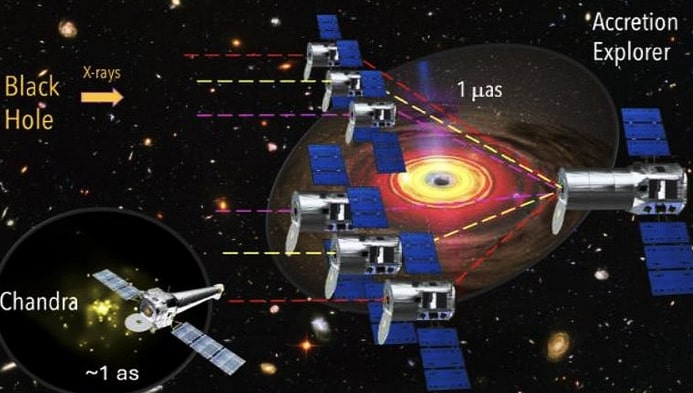
The Technology Behind the Mission
The sophistication of the technology lies in its ability to capture high energy wavelengths, providing an unparalleled view of the forces and phenomena within the accretion disks surrounding these black holes. The advancement in detection technology provides a higher resolution, which could reveal unprecedented details in the event horizons and enhance the data collected on the gravitational influences involved."Exploring the universe's most massive entities could unlock the secrets of the cosmos. Understanding supermassive black holes is akin to unlocking the door to a hidden universe." – Dr. Brian Greene
Potential Impacts and Future Prospects
By advancing X-ray technology, the mission paves the way for a deeper exploration of not only black holes but also the fundamental laws of physics. It could potentially lead to discoveries about dark matter, quantum mechanics, and spacetime relativity, rewriting textbooks and altering the basic principles of astrophysics.Prominent Collaborations
Several agencies and leading scientific institutions are collaborating on this mission. Joint efforts with international space agencies ensure a global exchange of knowledge and resources. Considerable contributions from prominent physicists and astronomers worldwide are set to further enrich the mission's success.Continued Research and Exploration
The pursuit of knowledge continues to drive humanity forward. As we strive to learn more about our universe, missions such as these are vital in assisting us towards unprecedented discoveries. The era of advanced space exploration has just begun, with each mission taking us closer to answering the age-old questions of our existence and the universe's future. Continue Reading at Source : Next Big Future
Tags:
Science
